
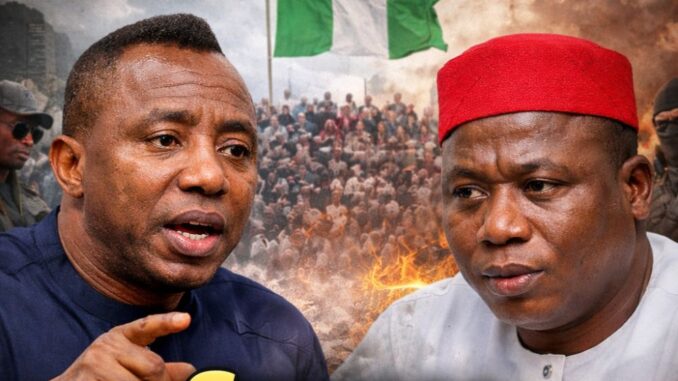
Sowore Challenges Sunday Igboho – Human rights campaigner and former presidential candidate of the AAC, Omoyele Sowore, has openly challenged Yoruba Nation Activist, Chief Sunday Adeyemo, popularly known as Igboho. He dared Igboho to stop him from campaigning in the 2027 presidential elections if he could. Moreover, Sowore emphasized that he intends to campaign freely across Nigeria, regardless of any intimidation attempts in the Southwest.
I will campaign anywhere in Nigeria, and I am eager to see him attempt to stop me. I am confident he will not try it. A lot of this is psychological — they use these individuals to instill fear in you, so you will not be motivated to vote in 2027.
Therefore, Sowore insisted that psychological tactics cannot sway his commitment. Furthermore, he explained that such strategies aim to discourage citizens from voting, yet he remains steadfast in pursuing active political engagement.
Additionally, Sowore criticized Igboho’s style of politics.
He said,
I don’t really know him well, but I have often mentioned that his type of politics is what they refer to as amala politics in Oyo State: it is a grab-and-take politics, and in the Southeast, it is described as ‘you scratch my back, I scratch yours.
Consequently, Sowore contrasted his approach, emphasizing transparency, accountability, and direct engagement with voters. Furthermore, he highlighted the long-term consequences of transactional politics on democratic development.
SEE ALSO,
Moreover, Sowore likened Igboho to political figures whose careers collapsed after supporting authoritarian regimes. He remarked,
I place him among figures like Arthur Nzeribe, who once pledged to die if Babangida did not ascend to the presidency, and Daniel Kanu, who made a similar vow for Abacha — both individuals whose political careers collapsed with the regimes they supported.
Therefore, Sowore suggested that opportunistic activism carries inherent risks and short-lived relevance.
Sowore Challenges Sunday Igboho: Igboho Responds to Sowore
In response, Chief Sunday Adeyemo, also known as Igboho, delivered a strong rebuttal. He accused Sowore of failing to organize any protest when Igboho was attacked at his Ibadan home and later incarcerated. Additionally, Igboho described Sowore’s “Amala Politics” comment as insensitive and misleading, particularly considering the nature of his activism.
Through his media aide, Olayomi Koiki, Igboho stated,
We strongly reject the characterisation of Igboho’s activism as transactional. Such a myopic position misrepresents the intent and focus of our agitation on effective grassroots security in the South-West, and Nigeria as a whole. How many protests did Sowore organise to push for my freedom? Sowore’s claim of fighting for the masses contradicts his daily lodging expenses of N450,000 at a popular Lagos hotel.
Consequently, Igboho reinforced that his activism is principled, rooted in security and community welfare rather than personal gain or opportunism.
Furthermore, Igboho emphasized his constitutional rights and independence in political decision-making.
He said,
I cannot be compelled to endorse political figures such as Peter Obi or Atiku Abubakar, or even align with Sowore’s political platform. I have the right to make independent political decisions based on the security and collective interests of the Yoruba people.
Therefore, Igboho positioned himself as an autonomous actor prioritizing the welfare of his people over partisan alignment.
Moreover, Koiki clarified that Igboho’s activism focuses on tangible security improvements across Yorubaland.
He explained,
“While Sowore has consistently promoted nationwide revolution as a pathway to leadership, Igboho’s approach is rooted in protecting lives, land, and property within Yoruba territory. This agitation is a vivid response to real and ongoing threats faced by communities in the region.”
Consequently, Igboho’s method prioritizes immediate protection and pragmatic solutions over ideological movements or theoretical revolution.
Additionally, the statement highlighted the severity of ongoing insecurity.
Koiki noted,
“Labelling our agitation and noble efforts as ‘amala politics’ undermines the urgency of the security crisis and the legitimacy of grassroots agitation.”
Therefore, mischaracterizing his activism could downplay pressing threats facing communities in the Southwest, particularly among vulnerable populations.
Igboho’s office also cited the wide-ranging impacts of insecurity, stating,
“The impacts on vulnerable groups, including farmers, traditional rulers, women, and children, are massive, just as several communities have reportedly suffered destruction.”
Thus, Igboho called for sustained local action and regional security initiatives, highlighting the immediate needs of affected citizens.
Furthermore, Koiki referenced recent national events to illustrate the need for localized security efforts.
He added,
“Latest security incidents in Northern Nigeria, including reported explosions in Maiduguri as at yesterday, 16 March 2026, call into question the broader effectiveness of long-term revolutionary advocacy.”
As a result, Igboho’s approach underscores practical, results-oriented activism rather than abstract or nationwide campaigns.
Moreover, Igboho reiterated the long-standing nature of his activism, saying,
“These realities reinforce Igboho’s long-standing call, dating back to 2020, for localised security measures and stronger regional protection strategies.”
Consequently, his efforts reflect consistent commitment to the safety and welfare of his people over several years.
Sowore Challenges Sunday Igboho: Contrasting Approaches to Activism and Politics
The exchange between Sowore and Igboho highlights broader debates about activism, political strategy, and security in Nigeria. On one hand, Sowore advocates for nationwide revolutionary participation, emphasizing political engagement and challenging opposition threats. On the other hand, Igboho emphasizes pragmatic, localized measures to protect communities and lives in the Southwest. Furthermore, both figures claim moral legitimacy and democratic responsibility, yet their methods and philosophies diverge sharply.
Moreover, this dialogue sheds light on the intersections of politics and security ahead of the 2027 elections. Sowore’s approach mobilizes national attention, calling citizens to actively participate in shaping political outcomes. Meanwhile, Igboho’s method emphasizes protecting immediate interests of local communities and addressing threats that could destabilize regional development. Consequently, their confrontation invites discourse on effective activism, community safety, and political participation in contemporary Nigeria.
In conclusion, the interaction between Omoyele Sowore and Chief Sunday Igboho continues to spark public debate. Sowore’s nationwide political activism challenges opposition figures across Nigeria, while Igboho defends his localized, security-driven agenda. Moreover, their exchange underscores important questions about the role of activism in ensuring democratic participation, regional safety, and responsible political engagement. Ultimately, this ongoing debate will likely influence political discourse, campaign strategies, and grassroots mobilization as Nigeria approaches the 2027 presidential elections.
Leave a Reply