
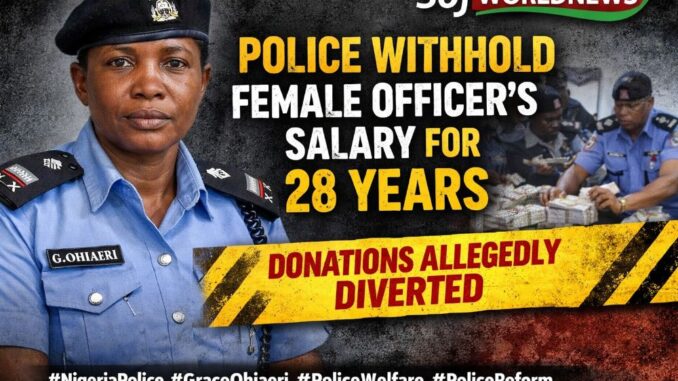
The Nigeria Police Force is facing intense scrutiny following disturbing allegations that it withheld the salary of a female police officer, Corporal Grace Ohiaeri, for nearly three decades. Reports indicate that while the officer struggled without her rightful earnings, senior officials allegedly diverted approximately N20 million in donations raised to support her. The revelations, first reported by Sahara Reporters, have reignited debates about accountability, transparency, and the welfare of rank-and-file officers in Nigeria.
Grace Ohiaeri’s Struggle: 28 Years Without Pay
According to multiple sources familiar with the case, Corporal Grace Ohiaeri, who served diligently in the police force, has not received her official salary for 28 years. The officer reportedly performed her duties with dedication, following the demands of her role, yet the system failed to recognize her service financially. For decades, she reportedly submitted requests for payment, provided documentation, and followed up with different departments, but her appeals allegedly went unanswered.
Observers argue that the prolonged withholding of her salary highlights systemic failures within the Nigeria Police Force. Experts note that such negligence not only affects individual officers but also undermines morale and commitment across the entire force. Officers rely on regular pay to support themselves and their families, and cases like Ohiaeri’s illustrate the human cost of administrative corruption.
SEE ALSO,
Daniel Bwala Faces Tough Questions In Al Jazeera Interview On Tinubu Government (Full Video)
Donations Diverted: Alleged Misappropriation By Senior Officers
In addition to the withheld salary, reports indicate that concerned Nigerians and sympathetic police officers had raised about N20 million to support Corporal Ohiaeri. The funds were meant to assist her financially and ensure she could manage her personal and professional life after years without compensation. However, multiple insiders alleged that the donations never reached the officer and were instead diverted by senior officials.
The alleged misappropriation of donations has sparked widespread outrage. Many citizens expressed disappointment that a system designed to support those who serve the public could allow funds intended for an officer’s welfare to be mishandled. Social media users, activists, and journalists have called the diversion a blatant example of corruption within the force.
The Human Impact: Life And Hardship Without Salary
For nearly three decades, Corporal Ohiaeri reportedly faced financial hardship, relying on family support and personal savings. Sources indicate that she could not afford basic necessities and had to navigate life without the income that should have been her right. Advocates stress that withholding salaries for such an extended period is not only unethical but also violates labor and human rights principles.
Her plight has become a symbol of broader challenges within the Nigerian police system. Analysts argue that officers at the junior level often bear the brunt of inefficiency, mismanagement, and corruption, while senior officers enjoy privileges and benefits without accountability. Grace Ohiaeri’s situation underscores the urgent need for comprehensive reform.
Public Reaction And Calls For Justice
The revelation of the officer’s ordeal has drawn strong reactions from civil society groups, human rights activists, and concerned Nigerians. Many have called for an immediate investigation into why her salary was withheld for so long and what happened to the donations raised in her name. Social media platforms have amplified the story, with hashtags like #GraceOhiaeri, #PoliceWelfare, and #NigeriaPolice trending as citizens demand transparency and justice.
Observers also argue that the case reflects systemic failures beyond a single individual. “Grace Ohiaeri’s case is not isolated,” said a police accountability advocate. “It shows the lack of transparency and accountability in salary administration and welfare management within the Nigeria Police Force. If such neglect happens to one officer, it could affect countless others.”
Administrative Failures Within The Nigeria Police Force
Experts highlight several administrative challenges that may have contributed to the prolonged withholding of salaries. These include:
- Poor record-keeping: Inadequate documentation of service and salary records may result in officers being denied pay.
- Corruption and mismanagement: Senior officers allegedly diverting funds intended for junior officers represents a significant governance failure.
- Lack of accountability: Systems for reporting financial abuse and following up on complaints appear weak or non-existent.
- Neglect of rank-and-file welfare: The absence of policies to ensure timely salary payment puts officers at risk of prolonged hardship.
These challenges have persisted for decades, experts say, and cases like Ohiaeri’s demonstrate the urgent need for structural reform and stricter oversight.
Why This Case Matters
The allegations against the Nigeria Police Force are not only about one officer’s suffering. They touch on larger issues of public trust, governance, and institutional integrity. When citizens see that funds and salaries meant to support officers are mishandled, it erodes confidence in law enforcement institutions and the government’s ability to maintain accountability.
Furthermore, the case highlights gender dynamics within the force. Female officers, particularly at lower ranks, may face greater challenges in advocating for their rights due to systemic biases and institutional neglect. Ensuring that officers like Grace Ohiaeri receive their rightful pay is not just a matter of justice—it is a step toward equity and fairness within the Nigeria Police Force.
What Needs To Be Done
Advocates suggest several steps to address the issue and prevent similar occurrences in the future:
- Independent investigation: Authorities should launch a transparent probe into why the officer’s salary was withheld for nearly three decades.
- Audit of donations: Funds raised to support the officer must be traced, and those responsible for misappropriation held accountable.
- Strengthen oversight: Implement stricter monitoring of payroll and welfare funds within the Nigeria Police Force.
- Institutional reform: Establish systems that protect officers’ rights and ensure timely payment of salaries, especially for junior staff.
- Public accountability: The force should publicly address these allegations and communicate the steps it is taking to resolve them.
Conclusion
Corporal Grace Ohiaeri’s ordeal represents a disturbing example of neglect and alleged corruption within the Nigeria Police Force. With 28 years of withheld salary and millions in diverted donations, her case underscores the urgent need for transparency, accountability, and structural reform. Citizens and advocates continue to demand justice, emphasizing that no officer should endure such hardship while serving their country.
As investigations unfold, all eyes remain on the Nigeria Police Force and the authorities tasked with safeguarding officers’ rights. The outcome of this case may not only bring justice to Grace Ohiaeri but also set a precedent for reforming systems that have long failed rank-and-file officers.
SOURCE: Sahara Reporters
Leave a Reply