
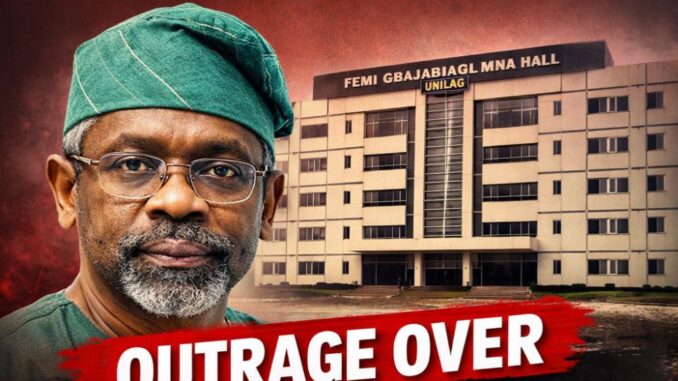
UNILAG N1.6bn Hostel Gbajabiamila – A N1.6 billion student hostel built at the University of Lagos (UNILAG) to address accommodation shortages has sparked widespread criticism after bedspace prices reportedly rose to nearly N1 million per session.
The hostel, facilitated by the Chief of Staff to President Bola Ahmed Tinubu and former Speaker of the House of Representatives, Femi Gbajabiamila, was originally intended to ease the housing burden on students but is now being accused of operating like a commercial private hostel.
Hostel Built With Public Funds
According to reports by SaharaReporters and BusinessDay investigations, the 484-bed hostel was constructed through a Zonal Intervention Project (ZIP) under the 2020 federal budget with an allocation of N1.6 billion.
The facility, named Femi Gbajabiamila Hall of Residence, was commissioned on January 3, 2024, and was expected to reduce the severe accommodation crisis facing UNILAG students.
However, findings show that students now pay between N710,000 and N950,000 per session for bedspace in the hostel, placing it far beyond the reach of many undergraduates.
Reports indicate that older university hostels still charge about N80,000 per session, making the Gbajabiamila hostel nearly ten times more expensive.
SEE ALSO: SERAP Pressures Senate President Godswill Akpabio to Reveal Officials in ₦200 Trillion NNPCL Probe
NAIRA VS DOLLAR: Nigeria Exchange Rates – Thursday, March 26, 2026
UNILAG N1.6bn Hostel Gbajabiamila: Students Lament High Cost
Many students expressed disappointment, saying the project has failed to serve the purpose for which it was built.
One student reportedly said the hostel was expected to provide relief but ended up becoming just another expensive private accommodation.
Another student noted that some private hostels around the campus even offer cheaper alternatives compared to the newly built facility.
The development has forced several students to seek accommodation far from campus, increasing transportation costs and academic stress.
UNILAG N1.6bn Hostel Gbajabiamila: UNILAG Management Defends Pricing
Officials of the University of Lagos have defended the pricing structure, stating that hostel fees fall under the administrative authority of the institution.
According to a university communications official, accommodation fees are determined based on maintenance costs, security, utilities, and operational expenses required to sustain the facility.
The official added that the hostel offers modern amenities and cannot be compared with older hostels within the university.
UNILAG N1.6bn Hostel Gbajabiamila: Public Funds And Commercialisation Concerns
Public finance and governance experts have raised concerns about the commercialisation of infrastructure built with taxpayer funds.
Analysts argue that government-funded projects are expected to prioritize accessibility and public benefit, especially in federal universities where affordability is crucial.
They warn that pricing public infrastructure at market rates risks defeating the purpose of government intervention and widening inequality among students.
Questions Over Constituency Projects
The controversy has also reignited debate over constituency projects and the practice of naming public infrastructure after political figures.
Experts emphasize that constituency projects are funded by taxpayers and should not be treated as private assets or commercial ventures.
They argue that such projects must remain accessible and affordable to the citizens they are meant to serve.
Gbajabiamila Yet To Respond
Efforts to obtain official comments from Femi Gbajabiamila regarding the pricing and management of the hostel have reportedly not yielded any response.
As criticism continues to grow, students and stakeholders are calling for greater transparency and a review of the pricing structure to ensure the facility fulfills its original purpose.
Growing Accommodation Crisis In UNILAG
The University of Lagos currently has over 50,000 students but fewer than 8,000 hostel bedspaces, forcing thousands to rely on private accommodation.
This shortage has driven rent prices around the campus to alarming levels, making affordable housing a major challenge for students.
Observers say unless urgent reforms are introduced, the gap between public education and affordability will continue to widen.
Source: SaharaReporters, BusinessDay Investigation
Leave a Reply