
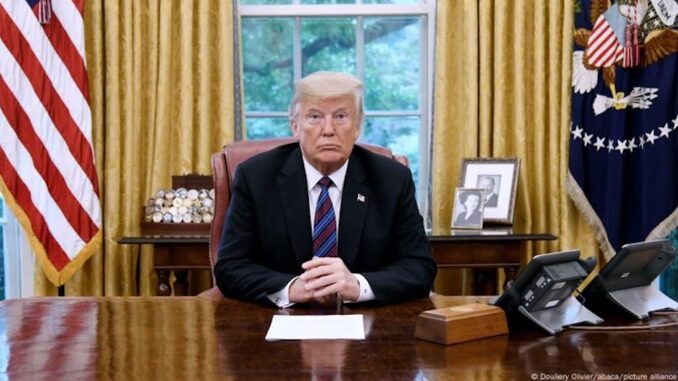
The administration of US President Donald Trump has imposed new travel restrictions on Nigerians seeking to enter the United States, targeting visa categories that account for the majority of visas issued to Nigerian nationals by US consular authorities.
Under the new measures, Nigerians are barred from entering the US as immigrants or on several non-immigrant visa categories, including B-1 (business), B-2 (tourism), combined B-1/B-2, F (academic studies), M (vocational studies) and J (exchange programmes).
These categories represent the bulk of visas issued annually by the US embassy and consulates in Nigeria, covering business travel, tourism, education and exchange programmes.
The White House announced the restrictions in a presidential proclamation published on its website on Tuesday.
READ ALSO:INSIDE LIFE: MAN Rapes 7-Year-Old Girl In Ekiti, Blames Devil For His Action
“The entry into the United States of nationals of Nigeria as immigrants, and as nonimmigrants on B-1, B-2, B-1/B-2, F, M, and J visas, is hereby suspended,” the proclamation said.
The US government cited security concerns and difficulties in vetting travellers as reasons for the decision, pointing to Nigeria’s prolonged security challenges.
“Radical Islamic terrorist groups such as Boko Haram and the Islamic State operate freely in certain parts of Nigeria, which creates substantial screening and vetting difficulties,” the White House said.
It also referenced visa compliance data, stating that Nigeria recorded a B-1/B-2 visa overstay rate of 5.56 per cent and an overstay rate of 11.90 per cent for F, M and J visas, according to the US Overstay Report.
The Trump administration said US consular officers in Nigeria have also been instructed to reduce the validity of any other non-immigrant visas issued to Nigerians “to the extent permitted by law”.
The restrictions follow Washington’s recent redesignation of Nigeria as a “country of particular concern” over religious freedom. Nigerian authorities have rejected claims that religious persecution drives the country’s security crisis, saying the violence is rooted in broader criminality and insurgency.
Despite the move, diplomatic engagement between the two countries has continued. On Monday, the US ambassador to Nigeria, Richard Mills, met with Nigeria’s foreign minister, Yusuf Tuggar, to discuss areas of mutual concern.
The proclamation also imposed partial travel restrictions on 14 other countries, expanding a list first introduced in June.
The additional countries are Angola, Antigua and Barbuda, Benin, Côte d’Ivoire, Dominica, Gabon, The Gambia, Malawi, Mauritania, Senegal, Tanzania, Tonga, Zambia and Zimbabwe.
The White House said the restrictions would take effect from January 1 and would apply only to foreign nationals outside the United States who do not hold valid visas on the effective date.
“The restrictions and limitations imposed by this proclamation are necessary to garner cooperation from foreign governments, including reducing overstay rates of their nationals, enforce our immigration laws, and advance national security and counterterrorism objectives,” the statement said.
Lawful permanent residents, holders of diplomatic visas, athletes attending major international events and certain special immigrant visa holders are exempt from the restrictions. The US also granted exemptions to persecuted ethnic and religious minorities from Iran.
In addition to the partial restrictions, the US imposed a total travel ban on Burkina Faso, Chad, Niger, Syria and Sudan.
The administration said the countries were subject to full bans because of concerns over fraudulent or unreliable civil documents, weak criminal record systems, corruption and instability that complicate vetting processes.
The proclamation also announced a ban on holders of passports issued by the Palestinian Authority, citing the war between Israel and Hamas in Gaza and the presence of Hamas in Palestinian population centres.
In June, Trump imposed a full travel ban on 12 countries, including Afghanistan, Myanmar, the Republic of Congo, Equatorial Guinea, Eritrea, Haiti, Iran, Libya, Somalia, Sudan and Yemen, while placing heightened restrictions on Burundi, Cuba, Laos, Sierra Leone, Togo, Turkmenistan and Venezuela.
US officials said the travel bans were intended to protect the country from terrorism and other security threats by limiting entry from countries where adequate screening and information-sharing could not be assured.
Leave a Reply