
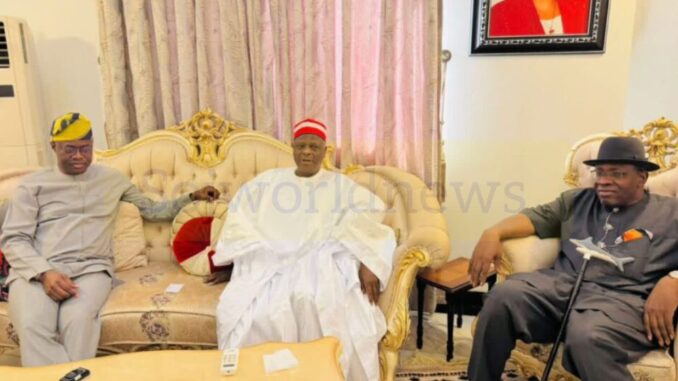
2027 strategic political meeting Ibadan & Kano, Nigeria — In a significant development in Nigeria’s evolving political landscape, Peter Obi, Seyi Makinde, and Rabiu Musa Kwankwaso held a high-profile meeting in Kano over the weekend. The encounter comes at a moment when reconciliation talks within the Peoples Democratic Party (PDP) appear to be stalling, and opposition forces are exploring alternative strategic pathways ahead of the 2027 general elections. 3
Political Realignments Ahead of 2027
As Nigeria approaches the 2027 general election cycle, political actors across party lines are engaging in consultations that may redefine the opposition landscape. The meeting in Kano involved leaders from different political backgrounds, spurring discussions on possible collaborations. Sources suggest that the engagement, though officially framed around Eid‑el‑Fitr celebrations, also served as a platform for strategic political dialogue. 4
Makinde and Kwankwaso initially met with PDP governors and other stakeholders before proceeding to Kano, where Obi joined the talks. Although public communications characterized the gathering as part of the festive period, political insiders believe the timing and the lineup suggest deeper consultations regarding coalition dynamics for 2027. 5
Stalled Reconciliation Within the PDP
The PDP has continued to grapple with internal tensions that threaten its unity and strategic positioning. Earlier attempts to reconcile dissenting factions—particularly between Governor Makinde’s camp and those aligned with Minister of the Federal Capital Territory, Nyesom Wike—have shown limited progress. Indeed, party structures have been contested in courts, and leadership disputes have surfaced ahead of the party’s national convention. 6
According to observers, the stalled reconciliation within the PDP has prompted key stakeholders to engage in cross‑party dialogues. This trend reflects growing concerns that without cohesive leadership and strategy, the PDP risks losing ground to the ruling All Progressives Congress (APC) in the next election cycle. 7
SEE ALSO: Exchange Rates in Nigeria Today – Dollar, Euro, Pound Rates for March 23, 2026
2027 strategic political meeting Nigeria: Insights From the Kano Gathering
While no official communique outlined the full agenda of the Kano meeting, credible sources close to Kwankwaso indicated that discussions were likely centered on coalition strategy, political realignments, and coordination among opposition actors. One insider remarked:
“You see, because of the Electoral Acts and the deadlines for the movement of politicians, high‑level consultation is still ongoing. Though this meeting is happening during the Eid‑el‑Fitr, of course, it’s also not just for the funfair. It’s part of the consultation ahead of the 2027 election.” 8
This statement suggests that beneath the celebratory context, critical political discussions were underway. Importantly, the range of attendees—a mix of PDP, NNPP, and other political actors—underscores the multi‑party nature of these consultations. 9
Kwankwaso’s Role and Approach
Kwankwaso, a former two‑time governor of Kano State and 2023 presidential candidate under the New Nigeria Peoples Party (NNPP), has maintained a prominent political profile. During a related engagement in Ibadan, he stressed that his meeting with Makinde was rooted in personal friendship rather than political negotiation, even as many observers saw strategic intent in the encounter. 10
Speaking to journalists after the Ibadan meeting, Kwankwaso said:
“This visit is more about personal friendship than party politics. Governor Makinde and I have known each other for a long time. Before proceeding to our party engagement in the state, I felt it was proper to pay him a courtesy call.” 11
He further reflected on his political history, noting his foundational role in the PDP and his subsequent shifts through various platforms. Although he reiterated that the visit was a courtesy call, analysts view such high‑profile interactions with Makinde and Obi as more than coincidental amid growing opposition coordination. 12
Obi’s Presence and Implications
Peter Obi, whose political influence continues to resonate since his 2023 presidential run, joined Makinde and Kwankwaso in Kano. His attendance marks a notable addition to the dialogue, as Obi remains an influential figure among opposition supporters. While neither he nor his team has provided detailed public statements about the purpose of the meeting, his presence alone signals a broadening engagement among non‑APC political forces. 13
Political strategists suggest that Obi’s involvement could boost efforts to forge a more cohesive opposition front. However, they caution that turning high‑level meetings into a robust coalition will require clear policy alignment and sustained collaboration.
What the Future Holds
As political negotiations intensify, Nigeria’s 2027 general elections appear poised to be a defining moment for the country’s democracy. With major parties and influential leaders exploring new alignments, the opposition landscape may shift in unforeseen ways. The Kano meeting—while officially consensual and celebratory—reveals how political consultations are taking place behind the scenes. 14
For many analysts, the key questions now include whether these consultations will evolve into a formal coalition and how the PDP will overcome its internal divisions. For the broader electorate, the outcomes of these negotiations could significantly shape the political choices and balance of power in the next election cycle.
Conclusion
The strategic meeting in Kano involving Obi, Makinde, and Kwankwaso reflects a dynamic phase in Nigeria’s political evolution. In the context of faltering PDP reconciliation, opposition leaders are actively engaging in cross‑party discussions that may set the tone for the 2027 elections. While the future remains uncertain, one fact is clear: Nigeria’s political landscape is undergoing realignment, and leaders are positioning themselves for what promises to be a competitive general election cycle.
Leave a Reply