
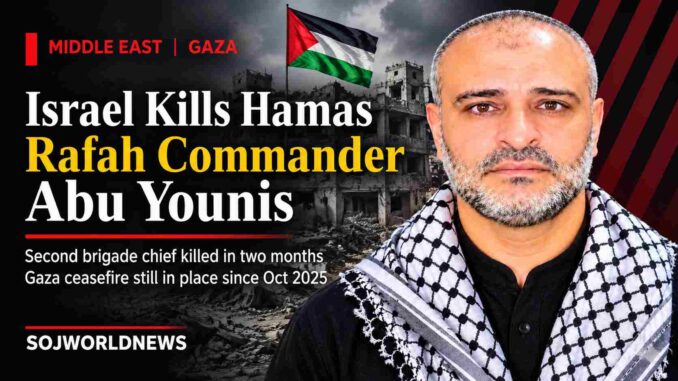
Israel has killed another senior Hamas commander in Gaza, and the strike underscores how fragile the October 2025 ceasefire remains. The man, Samir Abu Younis, led the Rafah Brigade of Hamas’s armed wing, and he took over the post only two months ago after Israel killed his predecessor.
Hamas’s Al-Qassam Brigades confirmed his death on Sunday and said he was 53. The group said Abu Younis joined its armed wing in 1991 and held several senior operational roles in Rafah before he rose to command the brigade. It also said he helped plan and oversee the October 7, 2023 attack on Israel. A funeral was scheduled for Sunday afternoon in Khan Younis.
The Israeli military initially announced that it had struck a senior commander in Hamas’s military wing without naming him. Later, it said Abu Younis died in an overnight strike in southern Gaza, just after midnight on Saturday. According to a security source quoted by AFP, the strike hit Al-Mawasi, west of Khan Younis. Gaza’s civil defense reported two additional injuries. The accounts differ slightly on the exact timing, since Hamas said he died Saturday while Israel described a strike shortly after midnight.
Israel accused Abu Younis of rebuilding Hamas’s strength. Its military said he was directing plans “to advance and carry out terror attacks.” The Israeli military also said he had led the Rafah Brigade since September 15, when an Israeli strike killed his predecessor, Nael Abu Obeid. Consequently, Israel has now removed two consecutive commanders of the same brigade in roughly 60 days.
The ceasefire, which took effect on October 10, 2025, halted major fighting after two years of war. However, it has not stopped Israeli attacks, and it has not secured the disarmament of Hamas. Gaza health authorities say at least 1,600 Palestinians have been killed since the truce began, while five Israeli soldiers have died over the same period. Both sides, meanwhile, accuse each other of violating the deal.
The pattern is not new. In December 2025, Israel killed senior Hamas commander Raed Saad, whom it described as one of the architects of the October 7 attack. Hamas condemned that strike as a “blatant violation of the ceasefire agreement,” and it said it had named a new commander without giving details. An Israeli military official countered that the truce allows strikes on targets actively engaged in terrorism. Therefore, each new killing reopens the same argument over what the ceasefire actually permits.
The larger numbers explain why the stakes remain high. Hamas-led fighters killed about 1,200 people in southern Israel on October 7, 2023, and they took 251 hostages. Israel’s military campaign afterward killed more than 74,000 people in Gaza, according to Palestinian authorities, who do not separate civilians from fighters in their count.
Several questions now hang over the truce. First, Hamas has not said whether it will retaliate or how it will name a successor. Furthermore, no U.S. reaction had been reported at the time of writing, even though Washington brokered the ceasefire. Still, the repeated killings of senior figures show that Israel intends to keep targeting commanders it believes are rebuilding the group’s military wing, even while the formal ceasefire holds.
The truce has also produced visible changes on the ground. Since it took effect, hundreds of thousands of Palestinians have returned to the ruins of Gaza City, Israel has pulled troops back from city positions, and aid flows have increased, according to earlier Reuters reporting. Critics of the strikes therefore warn that each killing puts those gains at risk, while Israel argues that it must stop Hamas from rebuilding.
Sojworldnews will follow any Hamas response and the status of the ceasefire as events develop.
Leave a Reply