
Sojworldnews • Politics • Flashback
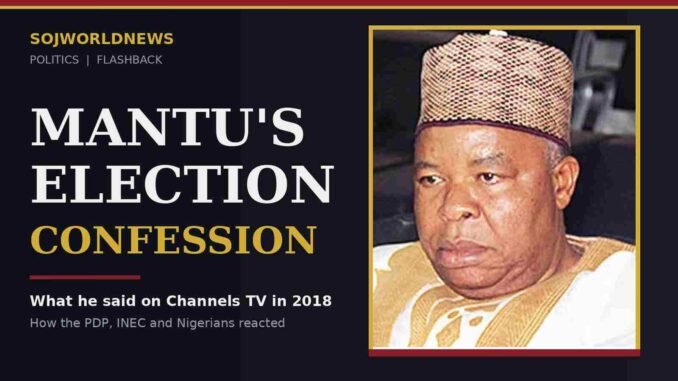
The Mantu election rigging confession still shapes the debate on vote buying in Nigeria. Former Deputy Senate President Ibrahim Mantu stunned viewers on 30 March 2018 when he admitted on live television that he helped rig elections. He made the remarks on the Hard Copy programme on Channels Television. Moreover, his words still surface whenever Nigerians question the credibility of their polls.
Mantu served as a senator on the platform of the Peoples Democratic Party (PDP). He also gained notoriety as a key figure in the third-term campaign of former President Olusegun Obasanjo. Therefore, his admission carried weight with a national audience.
Presenter Maupe Ogun-Yusuf pressed him to clarify the claim, and he answered without hesitation. “Yes, I did,” Mantu said, adding that he was now “confessing the truth.” He explained that he did not need to change results himself. Instead, he said, politicians give money to electoral officials so that they favour a particular candidate. In addition, he said he paid security agencies and even agents of rival parties so they would raise no objection.
Mantu said he spent about 40 years in politics, and he described a system that ran on financial inducement. He insisted that the effect stayed the same whether or not he touched a ballot. “I am rigging elections,” he said, because he supplied the money. Furthermore, he argued that the practice could end if players stopped paying, since nobody can take what nobody offers.
He also called himself a born-again politician. He said he was tired of foreigners treating Nigerians as suspected criminals because of their green passports. Consequently, he urged the country to change its political culture before the 2019 elections.
The confession triggered an immediate storm. The opposition All Progressives Congress urged the PDP to confess its own sins. However, the PDP rejected any link to Mantu’s claims. The party said it had “never directed or had any pact with him” to rig elections on its behalf. It also asked what happened to his “rigging machinery” when he lost his own 2007 senatorial race.
Meanwhile, civil society groups demanded action. Musician Charly Boy led the Ourmumudondo movement to the headquarters of the Independent National Electoral Commission (INEC) in Abuja. The group urged the commission to prosecute Mantu. Police sources, however, said they could investigate him only if INEC sent a petition.
The remarks matter because they describe a method rather than a single act. Under this model, payments reach officials, security agents and rival party agents long before results emerge. As a result, critics argue that investigators should look beyond the person who gives the money and also ask who accepted it. Notably, Mantu himself said nobody takes unless someone gives, which places blame on both sides.
Public anger spread quickly online. Many Nigerians on social media called for his arrest, while others asked why security agencies had not acted sooner. Some users even questioned which winning politicians still hold power because of such methods. Consequently, the debate moved from one man’s words to the wider system.
Others saw the admission as a symptom, not an exception. Former presidential aide Doyin Okupe said Nigerian politicians and parties have rigged elections since 1959. Similarly, a Vanguard editorial argued that “rigging is a form of corruption that underpins all elections in Nigeria.” The editorial dared any politician who has won an election to cast the first stone.
Mantu died in 2021, but the questions he raised remain. Can Nigeria stop vote buying if candidates, officials and security agencies all benefit? Can INEC prosecute offenders when confessions surface? Finally, will voters demand reform before the next election cycle? Sojworldnews will keep tracking these issues.
Sources: Channels Television, TheCable, BusinessDay, Sahara Reporters, The Guardian Nigeria and Vanguard.
Leave a Reply