
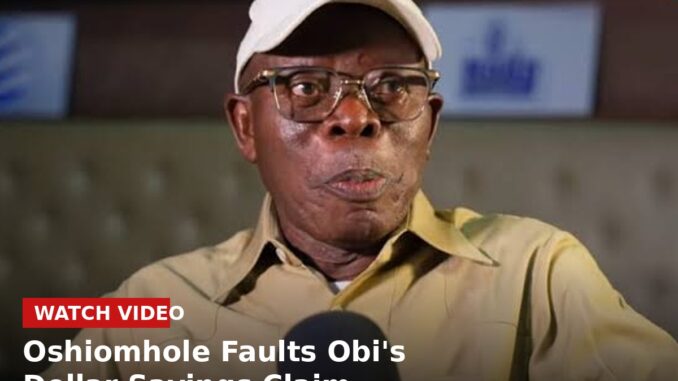
Watch Video: Oshiomhole Faults Obi’s Dollar Savings Claim, Says Governors Received Allocations in Naira
The Oshiomhole Obi dollar savings debate has taken a new turn. Former Edo State Governor, Adams Oshiomhole, has challenged Peter Obi’s claim that he saved dollars while governing Anambra State. In a video interview, Oshiomhole argued that states received their monthly allocations in naira, not dollars. Therefore, he questioned how any governor could have saved foreign currency from those funds.
Oshiomhole traced his argument to the National Economic Council, where the Vice President chairs meetings with the governors. According to him, the governors once asked the federal government to pay their allocations in dollars. “You earn the oil money in dollars, and then you change that official rate for the purpose of a federal account,” he said. Moreover, he noted that governors operate at the real market rate, which differs sharply from the official rate that manages the federal account.
However, the federal government rejected the request. Oshiomhole said officials insisted that the naira remains Nigeria’s recognised currency. As a result, every allocation reached the states in naira. “So, I ask Obie, where did you get dollars to save?” he asked. He also wondered whether a governor would collect naira from Abuja and then bid for dollars on behalf of the state.
Furthermore, Oshiomhole backed the explanation that Anambra State Governor, Charles Soludo, offered on the matter. He urged critics to defer to Soludo on financial questions. “Soludo is the authority,” he said, citing the governor’s background as a development economist and a former Central Bank of Nigeria governor. In his view, Soludo’s record at the apex bank speaks for itself.
Oshiomhole then turned to the question of borrowing. He said Obi had claimed he never borrowed money, yet his administration accessed World Bank facilities. Oshiomhole said he also received such facilities during his tenure, including budget support instruments. “They are loans,” he stated plainly. Nevertheless, he noted that Obi described them as loans that fall due later.
Oshiomhole rejected that reasoning. He explained that a loan does not stop being a loan because repayment starts years later. Instead, the obligation stays in the books, and a future government must pay it. Moreover, a moratorium often means the borrowing governor leaves office before the repayment date arrives. “It’s in the books,” he said, adding that this is why the claim of never borrowing does not hold.
In addition, Oshiomhole dismissed another claim linked to Obi. He said the Director-General of the Debt Management Office supposedly organised a reception to praise Obi for not applying for any loan. “That’s another lie,” Oshiomhole declared. He also advised commentators and interviewers to listen to the fine details of such statements instead of accepting headline claims.
Meanwhile, Oshiomhole admitted that parts of his response might sound petty. Still, he insisted that he spoke from experience, since he sat with Obi at the National Economic Council. For that reason, he said, he understands how allocations, exchange rates, and loan facilities work in practice.
The remarks have since drawn attention online, and many Nigerians continue to debate the issue. Some viewers side with Oshiomhole’s explanation of the naira allocations, while others want a direct response from Obi. Finally, the Oshiomhole Obi dollar savings exchange renews a wider conversation about state finances, foreign exchange, and how governors describe their debt records to the public.
Watch the full video above to hear Oshiomhole’s argument in his own words. Sojworldnews will update this report as reactions emerge.
Leave a Reply