
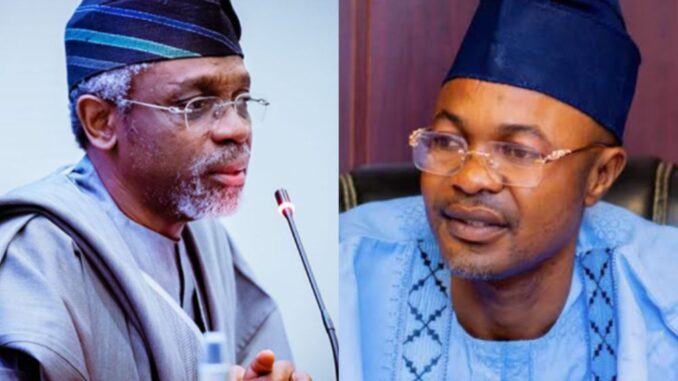
Nigeria’s Presidential Foreign Intervention Promotion Council (PFIPC) scandal escalated dramatically this week, as police arrested the self-proclaimed director-general after he missed a scheduled court appearance, and lawmakers blocked a full Senate probe into the ₦1.3 billion budget allocation tied to the phantom agency.
Prince Adeniyi Adeyemi failed to appear before the Federal High Court in Abuja on Tuesday for his arraignment on an eight-count charge covering forgery, fraud, and impersonation. Consequently, Justice Mohammed Umar issued a bench warrant after a police lawyer made an oral application requesting it. Shortly afterward, officers from the Intelligence Response Team tracked Adeyemi down in Osun State and took him into custody.
“We have just confirmed the arrest of Mr. Adeniyi Adeyemi by a team of the Intelligence Response Team (IRT) in Osun State,” said police spokesperson Okokon Iniedu.
Meanwhile, footage circulating after the arrest showed Adeyemi being questioned by operatives. Prior to his capture, however, he had denied evading investigators, insisting instead that he was simply unavailable.
Perhaps most damaging to the presidency, Adeyemi has repeatedly alleged that he paid ₦400 million through a proxy to secure his appointment as director-general — a payment he claims went to Chief of Staff Femi Gbajabiamila.
SEE ALSO: Currency News Today: Naira, Dollar, Euro and Crypto Rates for July 15, 2026
Gunmen Kill Lagos NURTW Organising Secretary, Toba Ajiboye
“I did not prepare or defend any budget, and nobody went to defend it on my behalf,” Adeyemi said in an earlier interview, adding that he was detained for 23 days while the 2026 budget was being finalized.
Gbajabiamila’s legal team, for its part, flatly rejects the claim. His lawyers insist he has “never had any contact whatsoever with Adeyemi,” and the Chief of Staff has since threatened a ₦10 billion defamation suit. Furthermore, according to reports, individuals who allegedly lent Adeyemi the ₦400 million have since petitioned the Economic and Financial Crimes Commission (EFCC) to recover the funds.
Even so, accountability efforts have stalled at the legislative level. Senator Suleiman Kawu (APC, Kano South) pushed for a comprehensive Senate investigation into the council’s budget and operations, citing Order 9 and Rule 9(c) of the Senate Standing Orders. The Upper Chamber, however, rejected the motion outright.
“History will judge us,” Kawu warned colleagues, according to Vanguard News.
Legislative sources say the PFIPC budget line never went through the mandatory defense process before the Committee on Establishment and Public Service Matters, chaired by Senator Cyril Oluwole Fasuyi. Instead, insiders describe the allocation as having received a “hand-shake approval,” slipped into the appropriations bill without the standard vetting that other agencies undergo.
The scandal centers on how an agency with no legal existence secured office space inside the Federal Secretariat in Abuja, hosted government officials and foreign visitors, and allegedly opened multiple bank accounts — including with the Central Bank of Nigeria. Notably, a PFIPC signage remained posted at the Ministry of Health wing of the Secretariat until this month, directing visitors to the council’s offices.
“The same acclaimed non-existent agency has a domiciliary account, a pounds sterling account and a Treasury Single Account, all domiciled in the Central Bank of Nigeria,” Adeyemi said in a viral video, framing the banking access as proof the operation had institutional backing.
According to columnist Tunde Rahman, Senior Special Assistant to President Tinubu on Media and Special Duties, the episode exposes systemic rot rather than one man’s scheme.
“The PFIPC scandal is a stress test, and the system failed at three points: budget, appointment, and banking,” Rahman wrote.
In response to mounting pressure, President Bola Tinubu directed the Independent Corrupt Practices and Other Related Offences Commission (ICPC) to investigate the matter, giving the agency 30 days to conclude its probe. Additionally, the president tasked the Department of State Services (DSS) and the EFCC with unmasking any “internal collaborators” who may have helped Adeyemi navigate the bureaucracy undetected.
Nevertheless, critics argue that an in-house investigation cannot substitute for independent legislative oversight — a concern that grew louder after the Senate’s rejection of Kawu’s probe motion. As the case moves back to court and investigators dig into the money trail, Nigerians are watching closely to see whether the fallout reaches beyond Adeyemi himself.
PFIPC scandal | Sojworldnews will continue to update this story as it develops.
Leave a Reply