
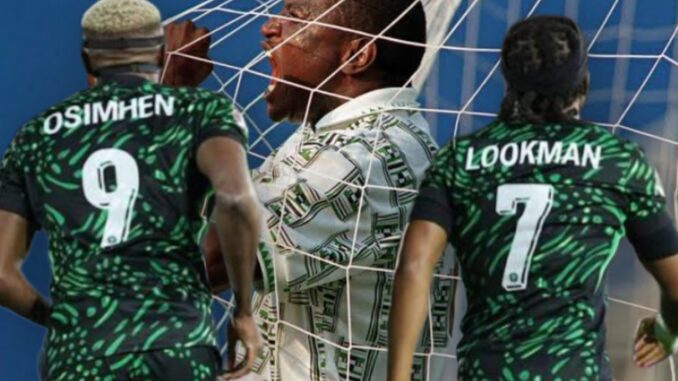
Between Lookman and Osimhen – Before Samuel Eto’o surpassed the African Cup of Nations (AFCON) goal record held by the late Ivorian legend Laurent Pokou, Nigeria’s own Rashidi Yekini had every chance to rewrite history much earlier. Sadly, circumstances beyond football denied him that moment.
Rashidi Yekini record – Ahead of the USA ’94 World Cup qualifiers and the Senegal ’92 AFCON, Yekini was Nigeria’s most feared striker. His reputation preceded him, and he duly delivered at Senegal ’92. Although stars like Emmanuel Amunike, Samson Siasia, Finidi George, Mutiu Adepoju and Daniel “The Bull” Amokachi raised their game during the tournament, internal disagreements and resentment toward Yekini began to surface.
By the time Nigeria qualified for the USA ’94 and France ’98 World Cups, cracks had appeared. Some supporting attackers—players expected to supply the main striker—seemed to turn against the gangling goal machine.
Yet history will always remember that iconic moment in Dallas: Nigeria’s first-ever World Cup goal, scored by Rashidi Yekini against Bulgaria, from a pass credited to one of Sunday Oliseh, Finidi George or Daniel Amokachi. Ironically, that defining moment appeared to mark the beginning of Yekini’s gradual isolation within the team.
Political events later compounded his misfortune. Nigeria’s diplomatic crisis with South Africa led to the Super Eagles’ withdrawal from the 1996 AFCON on the orders of the late General Sani Abacha. At the time, Yekini had 13 AFCON goals, just one behind Laurent Pokou’s record of 14. That boycott robbed him of a golden opportunity—one that never returned.
Efforts by Yekini to feature at the Ghana/Nigeria 2000 tournament reportedly fell on deaf ears, further deepening his estrangement from football authorities. From then on, he distanced himself from the Nigeria Football Federation and many former colleagues. Until his controversial death in April 2013, Yekini largely remained disconnected from Nigerian football structures.
That long-running bitterness was said to be the reason he declined participation in the USA ’94 reunion match against the Rest of the World in Abuja in 2006.
Today, the closest Nigerian striker to Yekini’s all-time national goal record is Victor Osimhen.
Before the recent clash against Mozambique, Osimhen stood on 32 goals. With better service, he could have scored multiple times. However, modern football, just like in Yekini’s era, is driven by individual ambition. Ademola Lookman—like Daniel Amokachi before him—also has personal goals. Against Mozambique, Lookman played a role in every goal, scored once himself and emerged Man of the Match.
Osimhen has now moved to 34 goals, just three shy of Yekini’s historic record.
Can Osimhen equal or surpass Rashidi Yekini at the ongoing AFCON? Yes.
Can he do it alone? Certainly not.
Football remains a team sport. Osimhen must balance personal ambition with collective success, understanding that other attackers also have dreams to fulfill. By helping them thrive, he ultimately helps himself.
A look back at Nigeria’s USA ’94 and France ’98 campaigns shows fierce competition among attackers like Siasia, Amokachi, Amunike and Finidi—yet unity kept the team functional. That lesson remains relevant today.
Head coach Eric Chelle must reinforce unity, emphasizing that national success outweighs individual accolades. Division has cost Nigeria dearly in the past, and history must not repeat itself.
Criticism of Osimhen should also be measured. He is passionate, committed and plays his heart out for Nigeria. While his temperament can sometimes flare, correction should come with understanding, not condemnation. Growth—mentally, emotionally and psychologically—will be key to reaching legendary status, an area where Lookman appears to show maturity.
Above all, one truth stands firm: Nigeria is greater than any individual.
Long live Nigeria.
Long live the Super Eagles.
Leave a Reply