
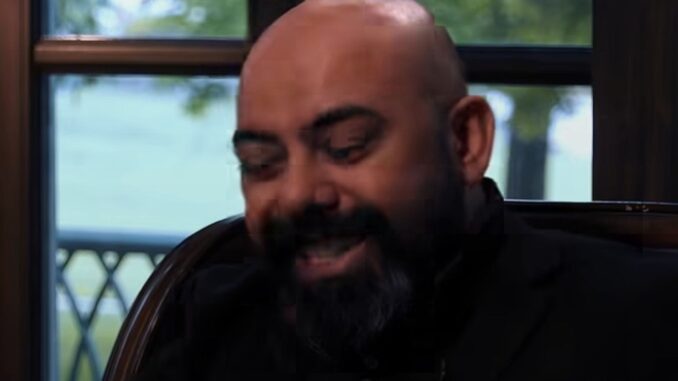
SOJWORLDNEWS | World Desk — Jordanian-born author Danny Burmawi has once again stirred controversy online. He argues that Islam functions as a political system rather than a private faith. Consequently, his comments have reignited a long-running debate about religion, politics, and Western identity.
Burmawi describes himself as a former Muslim who converted to Christianity. He was born in Jordan in 1988 and raised in a devout Muslim household. Later, he left the Middle East and relocated to the United States. Today, he leads the Ideological Defense Institute, an organization he founded to support other former Muslims.
In his recent remarks, Burmawi framed Islam as “not simply a private religion, but a political-theological system.” Furthermore, he has argued that Islam and Western civilization remain “fundamentally incompatible.” These positions form the core of his book, Islam, Israel and the West: A Former Muslim’s Analysis, released in October 2025.
According to Burmawi, mainstream discussions often soften Islam’s political dimensions. He specifically criticizes terms like “Islamism,” arguing they exist to shield Islam from scrutiny. Meanwhile, he positions Israel as central to what he calls a broader civilizational conflict. As a result, his commentary has found a receptive audience among some Western conservative and pro-Israel circles.
Nevertheless, his framing has drawn sharp criticism from multiple directions. Islamic scholars, interfaith organizations, and religious freedom advocates have pushed back firmly. They argue that reducing any single faith to a uniform political ideology erases enormous diversity within that religion. Indeed, critics note that the world’s roughly two billion Muslims span vastly different cultures, sects, and political views. Therefore, they say, sweeping generalizations obscure more than they reveal.
Similarly, mainstream religious freedom groups have historically warned against rhetoric that paints an entire faith as inherently dangerous. Such framing, they argue, risks fueling discrimination against ordinary religious adherents. Consequently, some commentators have accused Burmawi of promoting Islamophobic narratives under the banner of ideological critique.
On the other hand, Burmawi and his supporters reject that characterization entirely. They maintain that distinguishing between Islamic theology and Islamist political movements is not bigotry, but honest analysis. In fact, Burmawi frequently cites his own upbringing and years spent in the Middle East as the basis for his views. His supporters argue that his lived experience gives him unique standing to speak on the subject.
Still, the broader academic consensus differs sharply from his framing. Most scholars of comparative religion treat Islam, like Christianity and Judaism, as a faith tradition with diverse political expressions. They point out that plenty of Muslim-majority societies maintain secular governance structures. As a result, they argue, no single political system can fairly represent the entire religion.
Meanwhile, Burmawi continues to build a following through his books, podcast appearances, and social media presence. He has appeared on several faith-focused podcasts to discuss his conversion story and his critiques of Islamic political movements. Consequently, his reach continues to grow among audiences already sympathetic to his views.
For now, the debate shows no signs of slowing. Given the sensitivity of religious discourse, both supporters and critics are likely to keep the conversation alive across social media and podcast platforms in the coming weeks.
SOJWORLDNEWS presents this as a report on Burmawi’s stated public views and the criticism they have drawn, not as an endorsement of either position.
Leave a Reply