
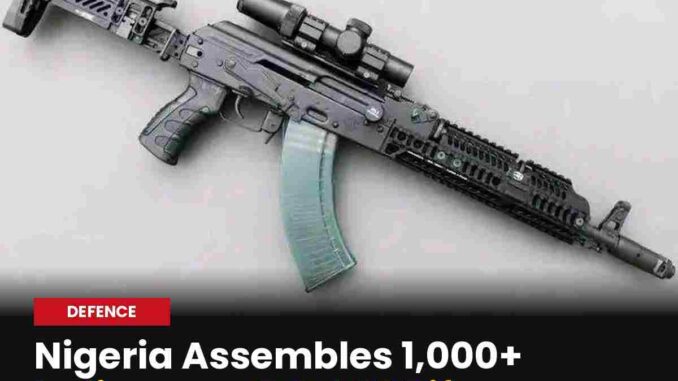
Nigeria has taken a major step toward making its own weapons. The Defence Industries Corporation of Nigeria (DICON), through its joint venture DICON-D7G, has assembled more than 1,000 DG-103 assault rifles at its Kaduna State facility. Moreover, the company says the rifles have passed testing and certification for the Nigerian Army. As a result, the project now stands as one of the clearest signs of progress in the country’s drive for defence self-reliance.
Company officials announced the milestone at a briefing in Abuja in November 2025. Osman Chennar, the chief executive of DICON-D7G, said the team reached the figure within two months of starting operations in Kaduna. However, reports differ slightly on the exact count. Some outlets say the plant produced nearly 1,000 units, while others report more than 1,000.
The DG-103 is a locally licensed version of the Russian Kalashnikov AK-103. It fires the 7.62×39mm M43 cartridge, and it keeps the rugged design that made the AK family famous. In addition, the manufacturer lists a rate of fire of about 600 rounds per minute. The rifle also reaches targets at distances of up to 500 metres, according to published specifications.
Chennar described the output as a “major breakthrough” in Nigeria’s renewed push for local arms production. He also said every rifle in the first batch met the operational standards of the Nigerian Armed Forces and other security agencies. Therefore, soldiers and police officers can expect locally built rifles to join their existing inventory.
The numbers matter because Nigeria has long relied on foreign suppliers for small arms and ammunition. That dependence often slows deliveries and raises costs. Consequently, officials now want to build a domestic supply chain that keeps troops equipped during a time of heavy security pressure. DICON-D7G aims to produce 60 million rounds of ammunition each year, which would ease one of the military’s most persistent bottlenecks.
The venture itself grew from a partnership between DICON and D7G Company Limited. Both sides signed a memorandum of understanding on January 18, 2024. Since then, the two partners have moved quickly from paperwork to production. Meanwhile, DICON has also resumed arms and ammunition manufacturing after years of suspension, following government reforms and new funding.
Officials link the project to the federal government’s Renewed Hope agenda. Chennar called DICON-D7G “a central player” in the defence industrialisation part of that plan. Furthermore, he said the company wants to export defence products to other African countries once it builds enough capacity. That ambition would turn a costly import habit into a possible source of revenue.
The company has not limited itself to rifles. Chennar said DICON-D7G also produces drones and anti-drone systems with early-warning features for frontline troops. In addition, the firm planned to acquire a military jetty in Lagos to host a production line, warehouses and accommodation for staff. Later reports say Chennar confirmed work on that jetty, and the company has since signed a deal with an Egyptian firm to build armoured vehicles in Nigeria.
Turkish partnerships have also entered the picture. Chennar said DICON-D7G can act as a bridge between Nigeria and more than ten Turkish defence firms. He called that role “a game changer” for quality materials and long-term self-sufficiency. Likewise, supporters argue that such links will help Nigeria build skills, not just assemble imported parts.
Still, challenges remain. Assembling rifles still differs from building every component at home. Nigeria must therefore expand local production of parts, steel and ammunition to reach full independence. Furthermore, the plant must keep quality high as it raises output, and it must deliver rifles to the troops who need them most.
For now, the Kaduna facility offers a hopeful sign. It shows that Nigeria can assemble certified service rifles on its own soil, and it gives the army a growing source of modern weapons. If DICON-D7G sustains its pace, the country could cut import bills, create skilled jobs and strengthen its security forces. The next test will be whether the factory can turn this fast start into steady, large-scale production.
Sources: News Agency of Nigeria, The Defense Post, Militarnyi, Military Africa, BusinessDay
Leave a Reply