
Sharia law Burkina Faso|Sojworldnews
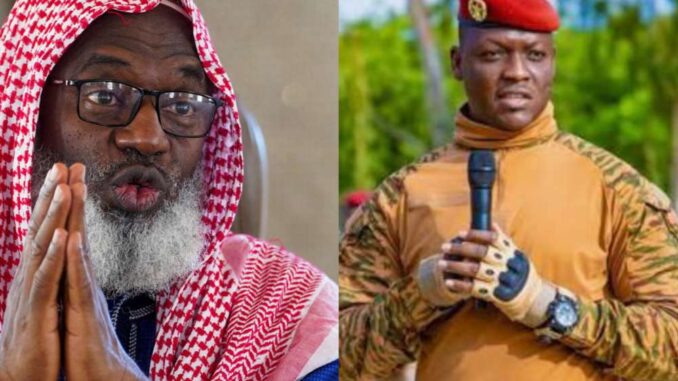
Nigerian Islamic scholar Sheikh Ahmad Gumi has launched a sharp attack on Burkina Faso’s military leader, Captain Ibrahim Traoré, after Traoré firmly rejected the idea of introducing Sharia law in his country. Consequently, the clash between the two figures has ignited fresh debate across West Africa about religion, governance, and security.
Traoré made his position clear during a recent national address. Although he identifies as Muslim, he insisted that every citizen deserves the freedom to practice their own faith without the state imposing religious law. In his words, “there will never be Sharia law in this country.” Furthermore, he directed sharp criticism at young Burkinabè who travel to Saudi Arabia to study Islamic jurisprudence, urging them instead to pursue technological and vocational skills that could genuinely benefit national development. He even suggested that some of these students should simply stay abroad rather than return home.
Meanwhile, Traoré’s stance did not emerge in isolation. Indeed, his government recently passed a new religious freedom law, and this legislation avoids naming any official state religion or elevating one faith above another. Instead, it seeks to protect religious liberty while simultaneously preserving national unity and public security. Given the ongoing jihadist insurgency that has displaced both Christian and Muslim communities in the country’s north and east, the timing carries real weight.
SEEAL ALSO: Naira Exchange Rate Today, July 30, 2026: Black Market and Official Rates
Gumi, however, wasted no time responding. Writing on Facebook, he dismissed Traoré as too young and inexperienced to grasp such a weighty issue. Additionally, he argued that the 38-year-old leader lacks the depth of understanding needed to navigate the complex intersection of religion, society, and global politics. According to Gumi, Traoré’s military background, while notable, hardly qualifies him to make sweeping decisions about religious law and its place in governance.
More importantly, Gumi framed his objection in strategic rather than purely religious terms. He warned that Traoré’s anti-Sharia position could backfire dangerously, since it “given the extremists the weapon they need to conscript more foot soldiers.” In other words, Gumi believes that rejecting Sharia outright, rather than resolving tensions, might actually deepen them by giving extremist groups fresh material for recruitment propaganda.
This is not the first time Gumi has waded into sensitive debates around Islamist militancy. He has long favored dialogue over confrontation when addressing armed groups in Nigeria, and he has repeatedly argued that ignoring the underlying grievances driving extremism only fuels further violence. Therefore, his response to Traoré fits a broader, consistent pattern in his public commentary.
Nevertheless, reactions to Traoré’s stance have been overwhelmingly supportive among many observers, particularly online. One widely shared social media post praised the president’s position, noting that “no religious law is bigger than the constitution of a country.” Supporters argue that Traoré’s approach protects the country’s secular foundation while still allowing space for personal religious practice, and they see this balance as essential for a nation grappling with insurgency and internal division.
As a result, the disagreement between Gumi and Traoré highlights a deeper and increasingly urgent question facing many African nations: how should governments balance religious identity, national law, and security concerns amid rising extremism? While Gumi views secular governance as a potential vulnerability that extremists can exploit, Traoré and his supporters see it as the very foundation that keeps the country unified and resistant to religious fragmentation.
Ultimately, neither leader shows any sign of backing down. Traoré continues to champion a secular, constitution-first approach, while Gumi continues to caution against what he sees as naive dismissals of Sharia’s role in maintaining social order. Consequently, this exchange is likely to remain a flashpoint in conversations about religion and governance across the region for some time to come.
SEO tags: Sheikh Ahmad Gumi, Ibrahim Traoré, Burkina Faso, Sharia law, Islamic law Africa, West Africa security, religious freedom, extremism, secular governance, Nigeria Islamic scholar
Leave a Reply