
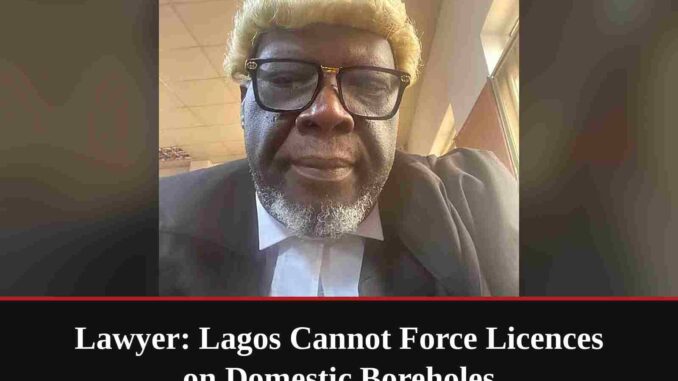
Lawyer Says Lagos Cannot Force Licences on Domestic Boreholes
Lagos State cannot lawfully force homeowners to license domestic boreholes, according to a formal legal opinion by lawyer George Bamidele Ogunjimi. He issued the opinion on October 31, 2026. He argues that LASWARCO, the state’s water regulator, cannot override a statutory exemption through directives, circulars or public announcements.
The opinion centers on section 43(1) of the Lagos State Water Sector Law. That provision lets individuals construct or extend boreholes on their residential premises without a licence, provided the water serves household needs. Ogunjimi says this creates a clear line between domestic boreholes and commercial groundwater extraction. However, he notes that the exemption does not excuse boreholes from environmental, technical and public-health rules.
Ogunjimi also stresses a basic principle of administrative law: public authorities must act within the powers their laws give them. “Any such requirement must have a valid statutory foundation,” he wrote. Therefore, he asks four pointed questions. Has the Lagos State House of Assembly amended section 43(1)? Does a valid regulation qualify the exemption? Does LASWARCO hold express authority to demand domestic licences? Is the government confusing registration, technical approval and licensing? He cites the ultra vires doctrine and points to two 1981 Supreme Court decisions, Attorney-General of Bendel State v Attorney-General of the Federation and Shitta-Bey v Federal Public Service Commission.
The lawyer does not dismiss the government’s concerns. Officials want to prevent groundwater contamination, control excessive extraction, protect public health and sustain water resources. Nevertheless, Ogunjimi argues that such goals do not automatically justify a blanket ban. Instead, he proposes less restrictive tools, including simple registration, construction and sanitation standards, water-quality testing, and minimum distances between boreholes and septic tanks. Moreover, he urges the state to close boreholes that pose genuine hazards. He also wants regulators to separate small household boreholes from large commercial and industrial facilities.
Constitutional rights feature prominently in the opinion. Section 20 of the Constitution makes the state responsible for protecting the environment, while section 36(1) guarantees a fair hearing and section 44 protects property interests. In addition, Articles 16 and 24 of the African Charter recognise health and environmental rights, and a 2002 United Nations committee comment recognises the right to safe and affordable water. Ogunjimi admits that these provisions give no unrestricted right to extract groundwater. He also concedes that section 20 is generally not independently enforceable because of section 6(6)(c). Even so, he says they reinforce the need to balance environmental protection with access to domestic water.
Sealing boreholes and prosecuting owners draws particular scrutiny. Before taking action, he says, authorities must identify the specific law allegedly broken. They must also confirm whether the borehole falls within the domestic exemption, whether it breaches environmental or technical standards, and whether officials followed proper procedures. In his words, a domestic borehole “cannot automatically be classified as illegal” simply because its owner holds no licence.
Residents who face enforcement have options, according to the opinion. They may challenge government actions as ultra vires, inconsistent with statute, unreasonable, disproportionate, procedurally improper or an interference with property. Depending on the case, they could seek declaratory relief, judicial review, certiorari or an injunction. Before filing suit, Ogunjimi advises them to gather a certified copy of the Water Sector Law, current LASWARCO regulations, any enforcement directive, and any amendment to section 43(1). They should also collect sealing or prosecution notices and evidence of public water supply in their communities.
The opinion closes with practical recommendations. Ogunjimi wants the state to respect the exemption, keep sensible standards and introduce simplified registration where the law allows. Furthermore, he calls for stricter licensing of commercial and industrial abstraction, transparent and affordable procedures, and an end to indiscriminate sealing. Above all, he urges government to improve public water infrastructure so residents depend less on private boreholes.
In his final position, Ogunjimi draws a firm distinction between regulating how people drill and prohibiting them from drilling at all. The first may serve legitimate public interests. The second, he argues, demands clear statutory authority. Until a valid law supplies it, the enforcement measures remain open to judicial scrutiny. The opinion does not include a response from the Lagos State Government or LASWARCO.
Leave a Reply