
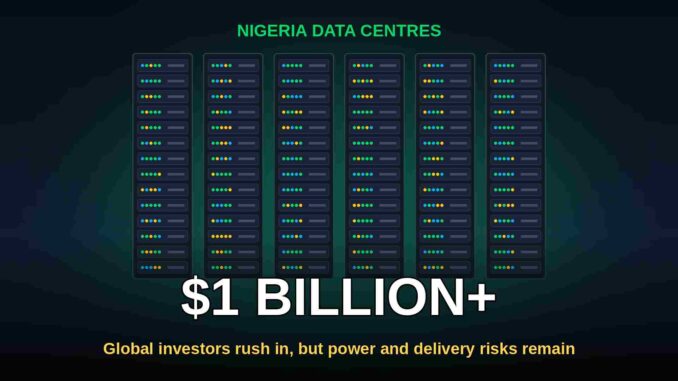
Nigeria data centres have attracted more than $1 billion in announced investments, as global technology companies and infrastructure investors race to capture rising demand for cloud computing, artificial intelligence, digital services and data storage. Nairametrics reported the figure on Saturday, November 7, 2026. The trend shows how quickly investors now see Nigeria as one of Africa’s largest and fastest-growing technology markets.
Several large projects drive the headline number. South African investor INFRAGORA Global Capital plans two AI-ready data centres in Lagos and Delta State, according to TechCabal and Africa AI News. The project could cost between $650 million and $1 billion, and construction is due to start in the second quarter of 2027. The sites would offer 60 to 70 megawatts at first, with room to grow to 100 megawatts if financing comes through.
Other developers are also moving. TechCabal reported that Kasi Cloud is building a 100-megawatt facility backed by an estimated $250 million in initial capital. Moreover, an earlier Leadership newspaper analysis counted about $285 million from MTN Nigeria for its Dabengwa data centre in Lagos and $240 million from Open Access Data Centres. Together, these commitments show that telecom giants and specialist operators all want a share of the market.
A new regulation adds more fuel. The Central Bank of Nigeria now requires banks, fintechs and other regulated financial institutions to store critical payment transaction data inside the country from January 2027. As a result, financial firms will need local space for their servers. Lars Johannisson, CEO of Rack Centre, said the industry is ready for the rush. “We are very much prepared,” he told Nairametrics. However, he admitted that some banks and fintechs still have to decide how they will migrate.
Johannisson also sees strong growth ahead. He expects the market to expand by about 24 to 25 percent a year, from roughly 60 megawatts of capacity today to about 224 megawatts by 2032. He noted that the real load in use may be about half of today’s capacity. Meanwhile, he said cloud and colocation business could grow by 30 to 35 percent annually.
Yet an announcement is not a building. Johannisson estimates that about 70 percent of announced projects will actually materialise, and he said many get delayed. Therefore, readers should treat the $1 billion figure as a set of promises, not cash already spent. Furthermore, INFRAGORA itself still needs to reach financial close before it breaks ground.
Power remains the biggest hurdle. Data centres consume huge amounts of electricity, and Nigeria’s grid struggles to supply it. Johannisson said the sector has long generated its own power, first with diesel and now with gas, and Rack Centre aims to draw 20 to 45 percent of its energy from renewables. Techeconomy likewise noted that INFRAGORA’s project will need reliable electricity to reach completion.
Other risks also loom. Some stakeholders argue that Nigeria still lacks enough AI-ready data centres, although Johannisson says Rack Centre can already handle heavy AI workloads with liquid cooling. In addition, he said a flood of new supply could push prices down over the medium to long term. Skilled workers are scarce too, because Nairametrics cited an industry survey showing that more than 67 percent of operators struggle to keep technical staff. To fix this, Rack Centre launched an academy to train young graduates.
For ordinary Nigerians, the stakes are real. More local capacity could mean faster apps, cheaper cloud services, more jobs and better control over national data. Nevertheless, delays and power shortages could slow those benefits. Investors have made their bets, and the next two years will show how many of them turn into working data centres. Sojworldnews will update this story as new projects and deadlines emerge.
Leave a Reply