
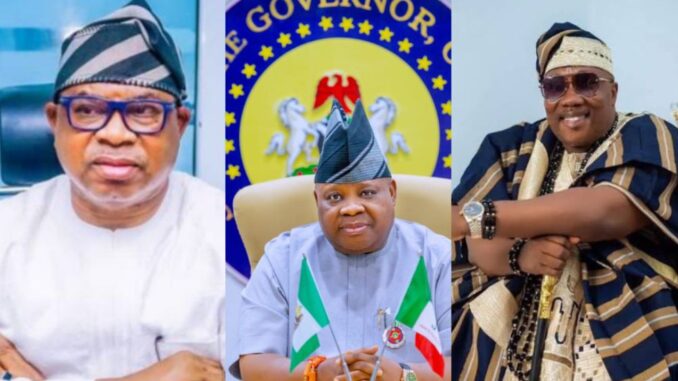
Osun State voters go to the polls on August 15 in what’s shaping up to be one of Nigeria’s most closely watched governorship contests. Incumbent Ademola Adeleke faces serious challenges from two well-known rivals in a race political observers say has no clear favorite.
Osun Decides 2026: Who’s Running
Fourteen parties cleared candidates for the race. Still, three names dominate the contest:
Accord
The incumbent governor, seeking a second term. He defected from the PDP to the Accord Party in December 2025 — a move that reshaped the entire race. As a result, this marks the first time in recent Osun history that a sitting governor is running for reelection under a different party than the one that first elected him.
APC
Known widely as “AMBO,” he previously led the Osun State Investment Company. He now serves as Managing Director of the National Inland Waterways Authority, and he carries the APC’s established party structure and campaign resources into the race.
ADC
A former Speaker of the Osun State House of Assembly, he served eight years in that role under ex-Governor Rauf Aregbesola. He hails from Ejigbo, a community with the second-largest voting bloc in the Ede Federal Constituency.
Notably, neither the PDP nor the Labour Party fielded a candidate this cycle. As a result, what many expected to be a straightforward PDP-APC contest has turned into a genuine three-way battle.
Osun Decides 2026: The Numbers
INEC says 2.3 million voters are registered across Osun’s 3,763 polling units in 30 local government areas. Even so, turnout — not registration — is the real question mark.
In the 2022 governorship election, for instance, turnout hit a record low of just 42.09%, despite nearly two million registered voters. Analysts point to insecurity, distrust in the electoral process, and general voter fatigue as contributing factors. Consequently, those same concerns are being raised again ahead of this vote.
Campaign Temperature Is Rising
The race has grown testy in recent days. Adeleke, for example, used a campaign rally in Osogbo to publicly press President Bola Tinubu to guarantee a credible election, warning against any attempt to manipulate the process. In response, Oyebamiji called the governor’s remarks a sign of anxiety over the likely outcome, insisting the circumstances of the disputed 2022 election “will not be repeated.”
Meanwhile, endorsements are splitting along interest-group lines. Farmers’ and butchers’ associations have backed Adeleke, citing his agricultural policies, while a hunters’ and forest security group has thrown its support behind Oyebamiji.
Despite the sharper rhetoric, candidates from all 14 parties signed a peace accord ahead of the vote, pledging a peaceful process. INEC, for its part, has issued its own warning against troublemakers on election day.
Why This Race Matters Beyond Osun
Osun has a reputation as one of Nigeria’s most fiercely contested electoral battlegrounds. Since the state’s creation in 1991, virtually every governorship election it has held — except the very first, in 1999 — has ended up in post-election litigation. The 2007 result, for example, was eventually overturned by the courts. Given that history, this year’s outcome, however close, is unlikely to be the last word.
What to Watch on and After August 15
- Turnout numbers against the record-low 42% seen in 2022
- Whether the Adeleke-Oyebamiji-Salaam race stays as tight as pre-election coverage suggests
- Any post-election legal challenges, given Osun’s near-unbroken history of election petitions
- How Adeleke’s PDP-to-Accord defection affects loyalty at the ballot box
Leave a Reply