
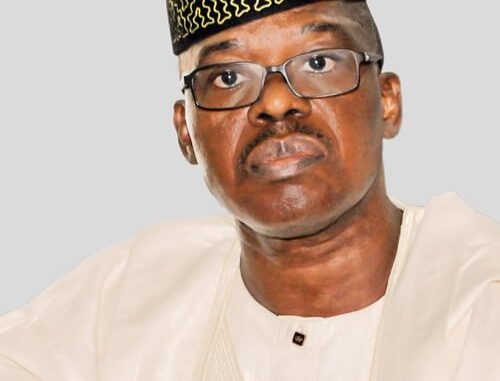
Segun Oni Nigeria democracy warning – Former Ekiti State Governor, Segun Oni, has raised deep concerns about the trajectory of Nigeria’s democracy and political system, warning that the country is gradually sliding into what he described as organised opportunism disguised as multi-party democracy.
Speaking during an exclusive media chat on Wednesday on Frontline, a current affairs programme on Eagle 102.5 FM, Ilese Ijebu, Ogun State, Oni offered a wide-ranging analysis of the economy, governance, and political structure, stressing that while some macroeconomic indicators show relative stability, the lived reality of Nigerians remains far more complex and troubling.
He acknowledged signs of improved investor confidence, linking it to perceived economic stability, especially in exchange rate management and broader macroeconomic predictability. However, he insisted that such improvements, while commendable, are not sufficient if they do not translate into tangible relief for ordinary citizens struggling with inflation and rising cost of living.
In his words, “I’m not surprised that foreign investors are getting more interested because where there is stability, of course, the investment world will take positive interest. The stability that we got is what we should be applauding as Nigerians because a few years back I said that the performance on the economy has been very commendable. The first thing that all of us must applaud is the stability because that is what brings investment.”
SEE ALSO: JUST IN: Gbajabiamila’s Explosive ‘Scatter Them’ Comment Triggers Political Storm
Oni stressed that economic stability, particularly in exchange rate behaviour, remains a critical pillar for investor confidence, but cautioned that stability alone does not equal prosperity. He noted that although the currency has shown signs of steadiness, the actual value remains weak, and that gap continues to affect inflation, purchasing power, and overall economic well-being.
He said, “The stability of the economic indices, not one today, fifteen tomorrow. The currency has been stable, and I’m sure investors from all over the world would note that positively. But we are not where we should be yet. The absolute value of the exchange rate is still important, and we still want to see improvement in the value of the Naira.”
The former governor further explained that inflation is deeply tied to exchange rate dynamics and domestic production capacity, particularly in the agricultural sector, which he described as the backbone of Nigeria’s economy but currently under severe pressure due to insecurity challenges affecting farmers across the country.
According to him, “The exchange rate boosts inflation, and inflation will be affected by domestic output. Domestic output, unfortunately, is suffering from the agri-sector where we are strongest, but it is suffering in the hands of insecurity. Farmers are not as productive as they should be because the security index is very poor, and this affects everything else in the economy.”
SEE ALSO: “I WARNED THEM!” — Gani Adams Disowns Southwest Insecurity Crisis, Blasts Governors
Oni also emphasised the role of security agencies, especially the military, praising their efforts while urging citizens to support them with credible intelligence. He argued that insecurity, including kidnapping and rural violence, continues to undermine economic productivity and creates fear even in areas not directly affected by insurgency.
He stated, “We must encourage the security agencies, especially the military, they are doing a commendable job. I believe citizens should find ways to complement them by passing credible intelligence so that they will be able to strike and strike accurately. When we hear of kidnapping or even rumours of kidnapping, everybody becomes jittery, and that alone affects economic activity.”
Shifting focus to the hardship experienced by Nigerians, Oni acknowledged the government’s reforms, including subsidy removal and foreign exchange unification, but noted that the transition has been painful for citizens. He argued that while reforms may be structurally sound, their impact on households remains severe and requires urgent mitigation strategies.
He explained, “The hardship will not go overnight, and we have to understand that. Government should do more to bring the hardship down, but it will not go overnight, and we must recognise that reality. The prices may be stabilising in some sense, but the pressure on citizens is still very high.”
On the issue of palliatives, Oni expressed caution, stating that while he is not a strong supporter of direct cash-style interventions, he believes structured and institution-based support systems are necessary to cushion the effects of reforms.
He suggested that schools, faith-based institutions, and structured community systems could be used as more efficient channels for relief distribution.
He said, “I am not a fan of palliatives, but we have to do it. There must be palliatives, and they must be done wisely and constructively. Institutions like educational institutions, institutions of worship and structured systems can be used to deliver support more effectively.”
When asked about the role of state governors in complementing federal efforts, Oni took a cautious position, saying he could not definitively judge their performance without access to internal financial data and subnational economic realities. However, he maintained that all levels of government must do more to reach citizens effectively.
He stated, “I cannot say they are doing enough or not doing enough because I don’t have access to the books. But I believe every level of government should be encouraged to do more and find constructive ways of meeting the citizens where they are.”
A major part of the conversation centred on Nigeria’s democratic structure and the growing dominance of the All Progressives Congress (APC), which currently controls a majority of states. Oni expressed concern over what he described as a drift toward a one-party dominant system, arguing that while multi-party democracy is important, excessive fragmentation weakens governance.
He said, “To be honest, we are regressing. We are on the reverse. What causes it is very simple. Going into so many political parties will never help democracy. If Nigeria had limited itself to three parties, we probably would be getting it better now. But 21 political parties or whatever number only creates opportunism.”
He further argued that political opportunism has become a major driver of defections and instability within parties, calling for a structured reduction in the number of registered political parties in Nigeria. According to him, many parties exist in name only and fail to meet meaningful electoral thresholds.
He added, “We are already corrupting democracy ourselves. Some of these parties will hardly campaign. If they get a thousand votes, it will be by mistake. So we should review the number of political parties and set standards that determine whether they remain active or not.”
On proposals to deregister or prune political parties based on performance, Oni suggested a yearly evaluation system tied to electoral results, arguing that such a framework would strengthen accountability and reduce waste in the democratic system.
He explained, “We should put a process in place to evaluate and weed political parties progressively every year based on performance. We should set a minimum percentage vote in national elections that a party must achieve to remain registered.”
Responding to criticisms that such a system may undermine democratic freedom, Oni argued that democracy must be guided by structure and measurable participation, not unlimited proliferation of weak political platforms.
He stated, “I don’t think we can take democracy in absolute terms. If a political party is acceptable, it will reflect in votes. If it is not acceptable, it will continuously fail. Should we continue to waste national resources maintaining parties that people do not support?”
The former governor also addressed the emergence of opposition coalitions such as the African Democratic Congress (ADC), noting that political mobility is natural but insisting that leadership failure within parties is often the root cause of fragmentation rather than ideology.
He said, “Political parties are about people. If people believe in you, they will support you. If they don’t, they will reject you. That is democracy. The people will decide, not just the big names moving from one party to another.”
On his personal political affiliation, Oni confirmed his membership of the APC, stating openly, “I belong to APC. I’m not ashamed or afraid to say it.”
However, he expressed no concern about defections or emerging coalitions, arguing that political movements are often cyclical and driven by performance failures within existing structures rather than genuine ideological shifts.
He explained, “Most of the big wigs have had opportunities to run their parties properly and did not. Setting up new parties is not an achievement. The real issue is poor management of political organisations.”
Oni concluded by calling for a deeper reform of Nigeria’s political party system, including stricter registration rules, performance-based evaluation, and a more disciplined democratic culture rooted in accountability and institutional strength.
He warned, “We must not be carried away by the noise of new political parties. Many of them are products of failed management elsewhere. If we don’t fix the system, we will keep recycling the same problems under different names.”
Keyphrase: Segun Oni Nigeria democracy warning


Leave a Reply