
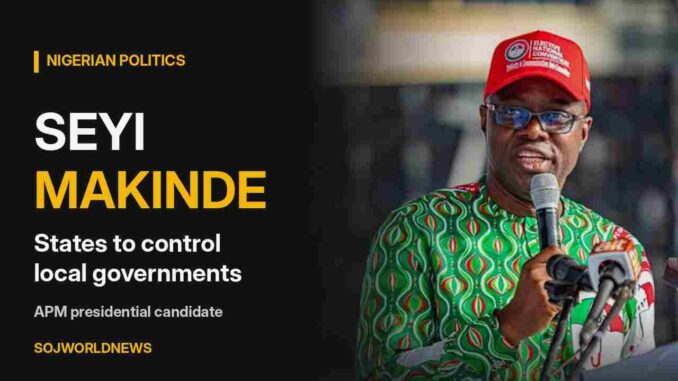
Makinde: States Will Control Local Governments If I Become President
Oyo State Governor Seyi Makinde says he will make states fully responsible for local governments if he becomes president. The Allied Peoples Movement (APM) presidential candidate made the remark on The Roof Top podcast on Sunday, November 22, 2026. He added that local governments must stop depending on federal allocation and learn to become productive. Consequently, his comments have reopened the debate on local government autonomy.
Makinde said he had already applied that approach at home. “I did it in Oyo State,” he said. He explained that his government does not give local governments “free access to their money” because it supervises their spending. According to him, the same idea would guide his policy if he wins the 2027 election.
In Oyo, the arrangement runs through the Joint Allocation Accounts Committee. Makinde has said before that local government funds from the Federation Account go into the JAAC account. The 1999 Constitution provides for a State-Local Government Joint Account, and the governor chairs the committee that manages it.
However, the issue has stayed contentious since the Supreme Court’s July 2024 judgment on local government financial autonomy. Supporters of that ruling argue that local governments should receive their allocations directly. Makinde has pushed back on how the debate is framed. He has argued that the federal government is not superior to the states. He has also criticised federal officials for blaming governors for misusing local government funds.
Makinde has defended his record before. He said that when his administration took over in 2019, local governments carried backlogs of salaries, gratuities and pensions. He also said Oyo has held local government elections twice and has no caretaker committees. These are his own claims, and independent figures would help voters judge them.
Critics have challenged him on the issue. Former Minister of Power and Steel Wole Oyelese said Makinde’s demand for federal accountability is legitimate but cannot be selective. He asked what happened to the funds due to Oyo’s 33 local governments over eight years. Separately, the campaign organisation of Senator Sharafadeen Alli, a rival political figure, accused Makinde of refusing to let local governments in Oyo function.
Makinde’s wider message is that Nigeria must reduce its reliance on federal allocation. In October, he told supporters that governments should encourage entrepreneurship and private investment instead of waiting for handouts. He also accused the federal government of withholding almost ₦250 billion in NLNG dividends due to each state. The Presidency has called that claim false.
In the same interview, Makinde said he would keep the Nigerian Education Loan Fund and expand it. He also put President Bola Tinubu’s chance of winning the 2027 election at 30 percent. He also said he is a better option than Peter Obi of the Nigeria Democratic Congress because he comes from the South-West. These are campaign claims, so voters will weigh them against the record.
The proposal raises a practical question. Would stronger state oversight help local governments spend wisely, or would it weaken the autonomy that the Supreme Court judgment aimed to protect? Supporters of state oversight say governors can prevent waste and coordinate services. Advocates of autonomy say elected councils need direct control of their money to serve their communities. Moreover, any change would likely require legal or constitutional steps, because the Supreme Court has already ruled on the matter.
Sojworldnews could not independently verify his description of how Oyo manages its local government funds. Readers can compare his remarks with the state’s published accounts and court rulings. Meanwhile, the debate over local government funds shows no sign of ending. Ultimately, voters will decide whether his plan strengthens local governments or leaves them with less control.
Leave a Reply