
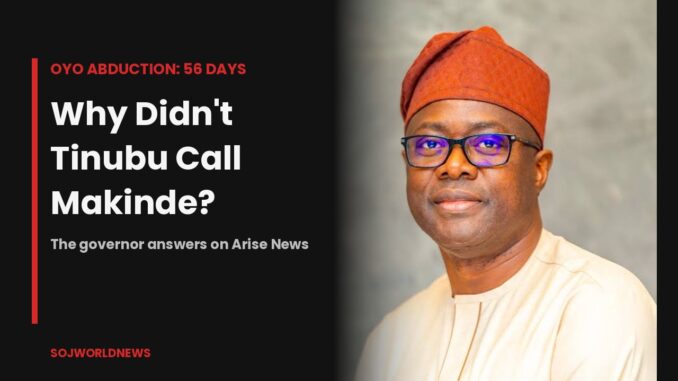
Oyo State Governor Seyi Makinde says he has not spoken directly with President Bola Tinubu since gunmen abducted pupils and teachers from a school in his state, even though the victims spent 56 days in captivity. Makinde made the revelation in an interview on Arise News, and his words have since reignited a heated debate about presidential leadership during national security crises.
The abduction happened on May 15, 2026, when armed men stormed a school in Oriire Local Government Area and seized dozens of pupils and teachers. Security operatives rescued the victims in July. Throughout those weeks, families waited anxiously while the state government worked with federal agencies to secure their release.
Makinde said he expected a call from the Presidency as soon as the news broke. “I mean, the president should be interested,” he told the interviewer, explaining that any part of Nigeria facing such a challenge deserves the president’s attention. However, the call never came. When the host asked whether Tinubu had phoned him, Makinde answered with a flat “No.”
The governor then described his own effort to reach the president. He called the chief of protocol, hoping to open a line to Tinubu. Unfortunately, the call went unanswered. “He didn’t pick,” Makinde said.
The host pressed him on the point. “So you’re telling me that for 56 days, your citizens were in the forest,” the interviewer said. “You tried to reach the president of Nigeria and he did not answer your call.” Makinde stood firm. “I’m saying it again that till tomorrow I have not spoken directly with the president on anything,” he replied.
Despite the strong claim, Makinde kept his tone measured. He said he is simply running his state and added, “I’m not complaining.” Nevertheless, the interviewer called the situation “very strange” and reminded the governor that he is the same man who helped Tinubu win the election.
The claim did not surface for the first time on Arise. Peter Obi, the presidential candidate of the Nigeria Democratic Congress, earlier said Makinde told him during a visit to Ibadan that no call had come from the president. Obi used the claim to criticise Tinubu’s handling of insecurity and renewed his call for the president to step down.
After the rescue, Makinde publicly thanked Tinubu and the security agencies for the children’s safe return. Some social media users seized on that statement to question Obi’s account. Still, Makinde’s latest remarks on Arise show that the question of a personal call remains unresolved in his own telling.
The Presidency has pushed back hard on the governor. Bayo Onanuga, the president’s special adviser on information and strategy, accused Makinde of playing politics after the governor called for a United Nations-backed probe into the abduction. Onanuga said the military and other agencies had already explained how the operation unfolded. Meanwhile, Senate-level allies of the president argued that a telephone call would not have freed the captives and that the government relied on strategy instead of political optics.
Supporters of the governor see the matter differently. They argue that a call is not a cheap gesture but a basic sign of leadership. In their view, a president who reaches out to a governor shows families that the whole country shares their pain. Conversely, critics say the focus on a phone call distracts from the more important result, which is that the children came home.
The exchange also carries political weight. Makinde has drawn attention as a possible national figure, and Tinubu’s team has already linked his criticism to wider ambitions. As a result, every statement from the governor now lands in a charged political climate.
For the families in Oriire, the rescue ended weeks of fear. For the political class, the debate continues. Makinde has made his position clear, and he has not yet heard a direct answer from the president.
Leave a Reply