
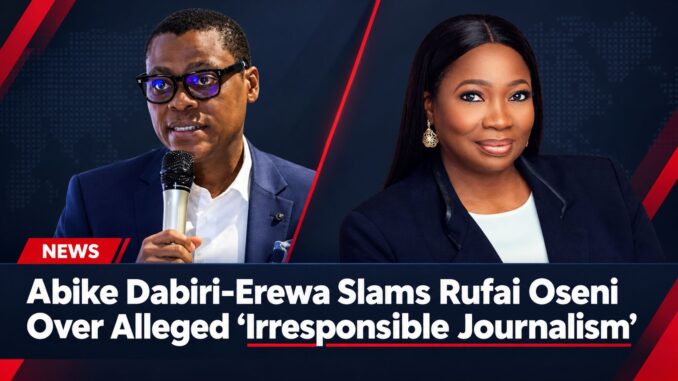
Abike Dabiri-Erewa Slams Rufai Oseni Over Alleged “Irresponsible Journalism”
Abike Dabiri-Erewa has accused broadcaster Rufai Oseni of irresponsible journalism. She says he wrongly claimed she called Igbo people monkeys and gorillas. The Nigerians in Diaspora Commission (NiDCOM) chairperson made the remarks while speaking at a recent public forum, where she also condemned the state of the profession.
Dabiri-Erewa explained that the controversy started on Twitter. According to her, a user who goes by the name “Voice of Igboz” abused her on the platform. Another user then replied to that post, and she responded with a smiley. Soon afterward, she says, Oseni stepped in and told his audience that she calls Igbos monkeys and gorillas.
She dismissed the claim outright. “So that is irresponsible,” she said. Furthermore, she insisted the allegation spread quickly once it went viral. Even friends and associates reached out to her about it. “You called Igbos monkeys and gorillas,” they told her, and she asked them where and how she had supposedly done so.
Dabiri-Erewa then argued that accountability must work in both directions. She said the press has every right to hold public officials responsible. However, she stressed that journalists must hold themselves to the same standard. “For you to hold any government official responsible, you must be responsible,” she declared.
Her criticism did not stop at one broadcaster. Instead, she widened it into a sweeping attack on the profession. “Journalism has gone to the dogs,” she said. She added that standards and values have disappeared, and that the journalism she was trained in no longer exists. Moreover, she insisted that the title of journalist should not belong to everybody. “That profession is destroyed,” she said.
At that point, she turned to the moderator, Dr. Reuben Abati, and urged him to act. “Dr. Abati, you must do something about journalism,” she said. Her appeal drew attention in the room, since Abati is a veteran journalist and former presidential spokesman.
Meanwhile, the exchange highlights a growing tension between public officials and media figures in Nigeria. Social media now carries claims and counterclaims within minutes, and a single post can shape public opinion before anyone checks the facts. Officials often complain that clips and screenshots strip away context. Journalists, on the other hand, argue that they have a duty to scrutinise those in power, and that robust criticism comes with the job.
Dabiri-Erewa’s account of the episode remains her own version of events. Oseni has not publicly responded to her latest remarks in the material available, and it is unclear whether he will. Readers should therefore treat her claim that he misrepresented her as an allegation until he addresses it.
Still, her message was clear. She wants the media to verify its claims, choose its words carefully, and respect the standards of the craft. “We will not accept irresponsible journalism,” she said. She also asked everyone present to stay mindful of their choice of words before returning to the podium to continue the programme.
The controversy shows how quickly an online exchange can grow into a national talking point. It also shows how fragile trust between government officials and the press has become, and neither side seems ready to back down.
Leave a Reply