
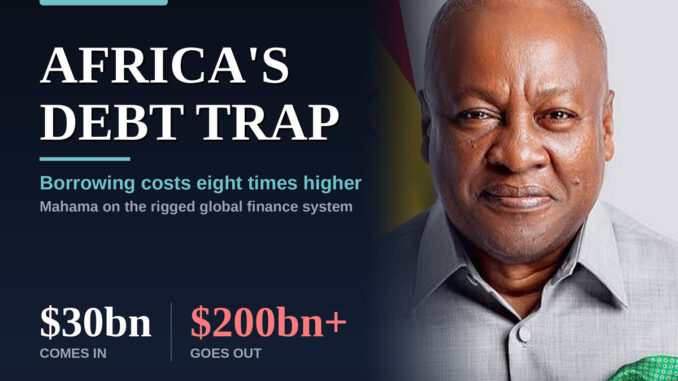
Ghana’s president says borrowing costs, illicit flows and falling aid drain the continent. He wants deeper reform of the global financial system.
Ghanaian President John Mahama says the Africa debt trap starts with the cost of borrowing. He spoke at the Council on Foreign Relations in New York last week. There, he argued that African countries pay far more for money than the rest of the world. As a result, he said, the global system works against the continent.
Mahama put the gap in blunt terms. “Africa borrows eight times more expensive than the rest of the world,” he said. According to him, that is where the trap begins. Moreover, he said the problem hits hardest in a crisis. When a humanitarian emergency strikes, African governments must borrow at those same high rates.
He used climate justice as an example. Africa contributed only about 4% of greenhouse gases, Mahama said. Even so, the continent faces all kinds of extreme climate events. Therefore, African governments must borrow expensively to repair the damage.
Next, Mahama turned to illicit financial flows. He estimated that $90 billion leaves Africa each year through mis-invoicing and transfer pricing by Western corporations. For example, a company can sell Nigerian oil cheaply to its own affiliate in Europe. The affiliate then earns the profit in Europe, so no tax reaches Africa. Mahama did not name specific companies. He used the Nigerian oil case only as an illustration.
Debt costs add to the drain. Mahama said interest and debt servicing take another $80 billion out of Africa. In addition, he said the risk premium that lenders charge adds $40 billion. Together, he argued, these channels remove more than $200 billion a year. Reports differ on his exact total, and one outlet put it at $240 billion.
Meanwhile, aid is shrinking. Mahama said official development assistance to Africa stood at $70 billion in 2023. By 2025, he said, it had fallen to $30 billion. “Thirty billion comes in, and two-hundred-and-something billion leaves Africa every year,” he said.
This imbalance explains what he means by a rigged world. Mahama said Africa wants a new global order and reform of the international financial architecture. In his view, debt treatment alone only soothes the symptoms. “Those are the things we want to change,” he said. “Not only the framework.”
Independent data supports part of his case. UNCTAD estimates that Africa loses about $90 billion a year to illicit financial flows. In addition, the region spent more than $101 billion on debt service last year, according to Brookings. As a result, debt payments now crowd out spending on health, education and social protection. More than half of low-income African countries sit in or near debt distress.
Aid trends also match his warning. The OECD estimates that official development assistance fell 9% in 2024. It projected a further drop of 9% to 17% in 2025. Consequently, African governments have less outside support just as repayments climb.
A separate analysis estimates that the so-called Africa premium in credit ratings costs the continent about $75 billion a year. In other words, lenders charge African borrowers more even when their economic profiles look similar to peers elsewhere. Meanwhile, S&P Global projects that Africa’s external sovereign repayments will exceed $90 billion in 2026. Therefore, critics say the pricing reflects perception as much as risk.
Even so, commentators stress that African governments cannot escape responsibility. One analysis of the speech made that point directly. It also noted that Mahama sees the debt problem beginning long before any IMF programme. Therefore, reform must work on both sides of the ledger.
Mahama’s speech adds fresh weight to calls for a fairer financial system. Whether creditors will respond remains unclear. Sojworldnews will report on any official reaction as it emerges. Meanwhile, readers can watch for responses from creditors, rating agencies and African governments.
Leave a Reply