
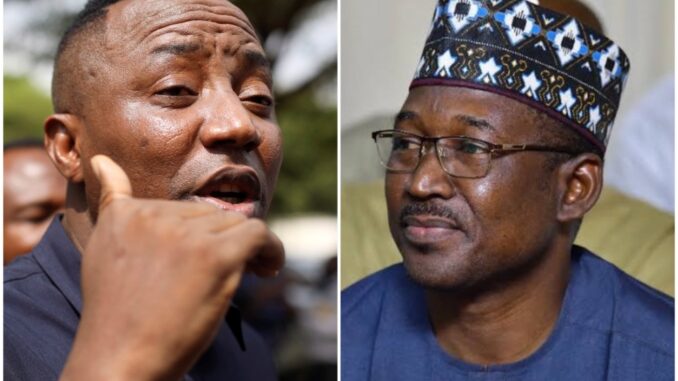
Tijjani Rabe responds Sowore NDLEA, SOJWORLDNEWS.
Tijjani Rabe responds Sowore NDLEA — The NDLEA Commander for Ogun State, CN Tijjani Rabe, has responded sharply to Omoyele Sowore. His reaction follows Sowore’s recent outburst against the agency over the destruction of cannabis farms. Rabe, therefore, wasted no time defending the institution and its officers.
Sowore had earlier criticised the National Drug Law Enforcement Agency (NDLEA) after operatives destroyed cannabis plantations linked to alleged trafficking networks. He argued that Nigeria should legalise and regulate cannabis instead of burning valuable crops amid widespread poverty. In his post, he wrote,
“You cannot burn your way out of poverty, foolish people!”
That remark, understandably, did not sit well with officers within the agency.
Rabe, in his response, opened with respect but quickly pushed back on the insult. He explained that NDLEA does not destroy farms arbitrarily. Instead, he insisted, the agency simply enforces a clear legal mandate handed down by Nigerian law. According to him, leadership should never rest on insulting institutions that sacrifice daily for the country.
Furthermore, Rabe highlighted the agency’s record over the past five years. He noted that NDLEA has made monumental drug seizures, stopping tons of illicit substances from reaching homes, schools, barracks, and motor parks. Beyond enforcement, he added, the agency has counselled and rehabilitated thousands of young Nigerians whose futures drugs had threatened. It has also dismantled cartels that funnel drug proceeds into kidnapping, banditry, and arms trafficking, he claimed.
Notably, Rabe challenged Sowore’s political ambitions directly. He argued that no one seeking to become Commander-in-Chief should simultaneously denigrate the men and women serving under that command. If Sowore disagrees with existing drug laws, Rabe suggested, the democratic path lies in sponsoring a bill to change them, not resorting to abuse.
Rabe also addressed the poverty argument at the heart of Sowore’s post. He acknowledged that Nigeria grapples with poverty, but he stressed that the country equally battles addiction, mental illness, and insecurity, all of which illicit drugs worsen. Consequently, he argued, the nation cannot solve one crisis while deepening another.
Turning to legalisation itself, Rabe urged caution rather than haste. He pointed to Canada as an example, noting that its illicit cannabis market still thrives years after legalisation. Given Nigeria’s current regulatory capacity, he warned, the outcome here would likely prove far worse. Without strong guardrails such as tracking systems, prescription monitoring, laboratories, and rehabilitation centres, he argued, legalisation would only expand the black market rather than shrink it.
Moreover, Rabe raised concerns about who truly controls many of these so-called economically viable farms. He alleged that armed networks linked to trafficking and violence run several of them. Legalising cannabis now, therefore, would hand legitimacy to those same networks rather than defeat poverty. Instead, he called for stronger investment in medical research and alternative development programmes that support farmers directly.
Rabe closed his response firmly, insisting that NDLEA will keep interdicting, destroying illicit crops, and saving lives until Nigeria builds the right foundation for regulation. As he put it,
“That is not idiotic, Sir. That is duty.”
Even so, he extended a measure of grace toward Sowore, noting that the political season often pushes people to say things for attention.
Ultimately, Rabe’s response reflects a deepening clash between enforcement-first drug policy and calls for regulated legalisation. While Sowore frames the debate around economic opportunity, Rabe frames it around security, public health, and institutional respect. As the conversation continues, Nigerians are likely to see more exchanges like this, especially as the 2027 election season draws closer and candidates sharpen their positions on national policy.
Leave a Reply