
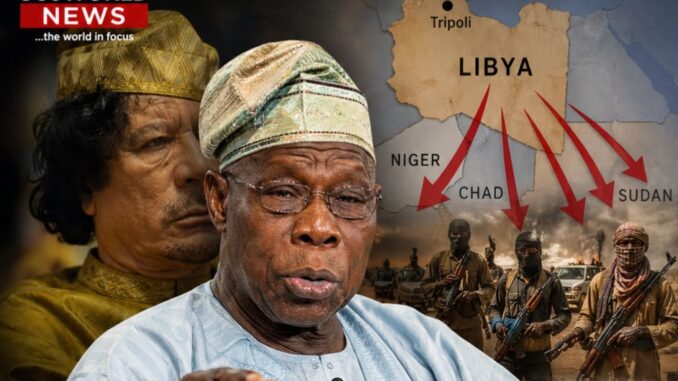
Obasanjo Gaddafi mercenaries Nigeria insecurity – Former President Olusegun Obasanjo has sparked fresh debate after linking Nigeria’s worsening insecurity to the aftermath of the 2011 killing of Libyan leader, Muammar Gaddafi, alleging that mercenaries trained under his regime later spread across Africa with weapons and military experience.
Obasanjo explained that Gaddafi had recruited fighters from several African countries, including Nigeria, and that after the Libyan civil war, many of these armed men dispersed across the Sahel region, worsening instability.
According to him, “Gaddafi recruited mercenaries from everywhere, including from Nigeria. When Gaddafi was killed, those mercenaries went their separate ways. A lot of them came to Nigeria with their guns, some started trading the guns.”
Obasanjo Gaddafi mercenaries Nigeria insecurity: How Libya’s Collapse Shaped Regional Insecurity
Security analysts and regional leaders have repeatedly linked the fall of Libya to a surge in arms trafficking and militant activity across West Africa.
Former President Muhammadu Buhari had also previously made similar claims, stating that instability in Libya led to the spread of heavily armed fighters across the Sahel, many of whom “learnt only how to shoot and kill.”
Reports suggest that the collapse of Libya created a major arms vacuum, with weapons looted from stockpiles flowing into countries such as Niger, Mali, Chad, and Nigeria, intensifying insurgencies and criminal networks.
Research also indicates that thousands of fighters who once worked under Gaddafi or were linked to his military structures migrated after 2011, contributing to conflicts in the region.
Obasanjo Gaddafi mercenaries Nigeria insecurity: Security Implications for Nigeria
Experts say Nigeria’s insecurity problem cannot be traced to a single cause, but the post-Libya arms flow added a dangerous layer to existing issues such as terrorism, banditry, and illegal arms proliferation.
The influx of sophisticated weapons has been linked to the activities of armed groups in the North-East and North-West, as well as rising banditry across rural communities.
Security observers also argue that weak border controls across the Sahel made it easier for weapons and fighters to move freely into Nigeria over the years.
What This Means Going Forward
Obasanjo’s remarks have reignited discussions on regional security cooperation and the need for stronger border surveillance across West Africa.
While some analysts agree that Libya’s collapse played a role, others caution against oversimplifying Nigeria’s insecurity crisis, pointing instead to governance gaps, unemployment, and internal security weaknesses.
Nonetheless, the statement highlights a widely accepted fact among security experts: the 2011 Libya crisis reshaped the Sahel’s security landscape in ways that are still being felt today.
Conclusion
The debate over the roots of Nigeria’s insecurity continues, but Obasanjo’s comments add to growing concerns that the ripple effects of Libya’s civil war remain a major factor in West Africa’s ongoing instability.
SEE ALSO: Lagos Was Nigeria’s Capital For 77 Years. The Full Story Of Why They Moved It Will Shock You.
“Where Is The Money?” — Sanusi Challenges FG Over Rising Debt After Subsidy Removal
Watch the full video and reactions as the debate intensifies.
“Gaddafi recruited mercenaries from everywhere, including from Nigeria. When Gaddafi was killed, those mercenaries went their separate ways. A lot of them came to Nigeria with their guns, some started trading the guns.” — Obasanjo on how insecurity spiralled in Nigeria pic.twitter.com/ymuJgsERW7
— TheCable (@thecableng) April 25, 2026


Leave a Reply