
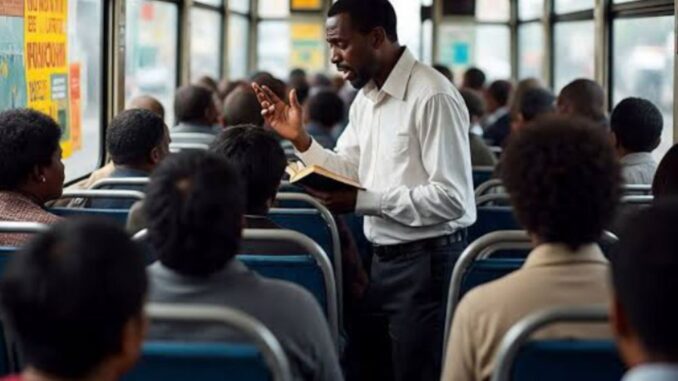
The Senate has clarified that the ban on preaching and hawking in commercial vehicles is not a new rule. Lawmakers say the provision has existed in Nigerian law since 2007.
The clarification follows public backlash over the Federal Road Safety Corps (Amendment) Bill, 2026. The bill proposes a N50,000 fine for anyone convicted of preaching, hawking, or trading inside a commercial vehicle. Many Nigerians criticized the provision on social media last week. Some accused the Senate of trying to outlaw religious expression.
The Office of the Senate Leader, Opeyemi Bamidele, issued a statement on Monday to address the concerns. The statement explained that both activities already qualify as offences under existing laws. It cited Section 10(4) of the FRSC Establishment Act and Regulation 220 of the National Road Traffic Regulations (NRTR) 2012 as the legal basis.
According to the Senate, the original Act entrenched the provision as Item 36 in the Second Schedule back in 2007. The amendment simply renumbers it as Item 49. Lawmakers insist they did not invent a new restriction; they only updated the numbering and penalty structure.
The Senate pushed back firmly against claims that it wants to silence preachers. It stressed that the bill targets safety, not faith.
SEE ALSO: Obi Rules Out 24-Hour Power Promise, Warns Against Unrealistic Pledges
Gumi Asks: Who Will Visit Boko Haram, Bandits Like Jonathan, Osinbajo Visited Militants?
“It is about the safety of commuters and other road users and is not intended to undermine any religious activity in the public space,” the statement said.
The Senate also drew a clear line between street preaching and preaching inside a moving commercial vehicle. Lawmakers said the bill does not touch public preaching in open spaces. It only restricts activity that could distract drivers or endanger passengers inside buses, taxis, and other commercial vehicles.
Lawmakers passed the amendment bill on July 16. The legislation forms part of a broader overhaul of FRSC penalties. It raises fines for numerous traffic offences, not just preaching and hawking. The revised schedule now lists 52 traffic violations along with updated penalties.
Under the new schedule, motorists who refuse to cooperate with FRSC officials during roadside breath tests will face a N50,000 fine. They could also serve six months in prison, or receive both penalties. The bill raises the fine for disobeying traffic lights, road signs, and pavement markings to N100,000.
Speed limit violations will also attract steeper penalties. The old fine stood at N5,000; the new one jumps to N100,000. Reckless driving convictions could bring a N100,000 fine, up to two years in prison, or both.
Senators say the review strengthens the FRSC’s enforcement powers. They argue it will improve compliance with traffic regulations and reduce crashes on Nigerian roads.
“Preaching and hawking in a commercial vehicle are offences. The offences have been part of the Act before the current amendment,” the Senate stated.
The bill has already gone to President Bola Tinubu for assent. It remains unclear when he will sign it into law. Until he does, the amendment stays a proposal rather than binding legislation, even though the underlying offences already exist under the older 2007 Act and 2012 regulations.
Public reaction to the bill highlights a broader tension in Nigeria. Citizens often view new penalties with suspicion, especially when the changes touch religious or economic activity. Hawkers and preachers frequently use commercial buses to reach captive audiences, so many fear losing income or outreach opportunities.
The Senate’s clarification aims to calm those fears. Lawmakers want Nigerians to understand that the rule protects commuters rather than punishes preachers or petty traders. Whether the explanation satisfies critics remains to be seen, but the chamber has now placed its position clearly on record.
Leave a Reply