
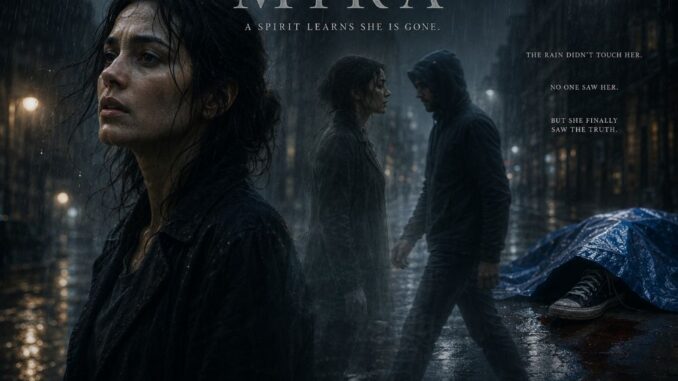
Rain does not always tell you what it means to fall through someone.
The first thing Mira noticed was that the rain didn’t touch her.
She was standing at the corner of Halloway and Ninth, where she always stood on Tuesday mornings, waiting for the light to change so she could cross toward the bakery that sold the burnt-sugar croissants she loved. The storm had rolled in fast, the way autumn storms do in this city, and she remembered — or thought she remembered — pulling her coat tighter against the first cold drops.
But the drops weren’t cold. They weren’t anything. They fell through the space where her shoulder should have been, and struck the pavement as if she were not there at all.
She looked down at her hands. They looked like her hands. Familiar knuckles, the thin white scar across her left thumb from a paring knife eleven years ago, the chipped polish she’d meant to redo before the weekend. Everything was where it should be. And yet when she reached out to touch the crosswalk sign, her fingers passed through the cold metal pole the way smoke passes through an open window — no resistance, no sensation, nothing but the vague impression of having tried.
She told herself it was a dream. People tell themselves that. It is, perhaps, the oldest lie the newly dead offer themselves, because the alternative arrives too quickly and asks too much.
The second thing Mira noticed was that no one looked at her.
This was, in itself, not so strange — people rarely looked at each other on Halloway Street, everyone hurrying with their heads bent against the wind, umbrellas up like black shields. But there was a specific quality to not being looked at that she began, slowly, to register. A man in a gray raincoat walked directly toward her, phone pressed to his ear, laughing at something the person on the other end had said, and he did not swerve. He did not apologize. He walked through her, and for one half of one second she felt something like being submerged in warm water — his laughter, his hurry, the taste of coffee still on his tongue, gone as quickly as it came — and then he was past her, three steps down the sidewalk, utterly unaware.
She stood very still after that.
There is a moment, she would later understand, when a spirit knows and does not yet know. The knowledge arrives in the body first — except there is no longer a body, and that absence is the first fact, arriving before the mind is ready to receive it. The rain that doesn’t wet you. The stranger who walks through you like a curtain of fog. The sound of your own voice, when you finally try to speak, that reaches no ears but your own.
Mira tried to speak. She said, “Excuse me,” to a woman huddled beneath the bakery awning, because it seemed like the thing to say to someone you have just failed to avoid colliding with, even though there had been no collision at all.
The woman didn’t turn. She was watching something down the street — an ambulance, lights washing blue and red across the wet pavement, parked at an angle that blocked half the intersection. A small crowd had gathered at a respectful, curious distance, the way crowds do, phones half-raised and then lowered again out of some last vestige of decency.
Mira walked toward it. Or she moved toward it — walking implied a body doing work, muscles and momentum, and she was beginning to suspect she no longer had those things to spend. She simply found herself closer, the way thought moves faster than legs ever could.
There was a shape on the ground beneath a yellow tarp that the paramedics hadn’t quite finished securing. One corner had come loose in the wind and flapped up, and underneath it Mira saw a shoe. Her shoe. The left one, the brown leather one with the small brass buckle, the one she’d bought two winters ago in a shop that didn’t exist anymore because the owner had retired to Portugal and everyone missed his terrible coffee.
She did not scream. She had expected, if this moment ever came — and some deep, unacknowledged part of her had always wondered if it might, the way everyone wonders, in the space beneath ordinary thought — that there would be screaming, or falling, or some dramatic collapse of the self. Instead there was only a terrible quiet clarity, like a window washed clean after years of grime, showing her a view she had somehow always known was there and had simply never had reason to look at directly.
“Oh,” she said. Just that. “Oh.”
She stayed at the corner of Halloway and Ninth for what might have been an hour or might have been a season — time, she was discovering, no longer moved in the reliable, metronomic way it once had. It moved instead the way attention moves: swift when there was something to hold it, glacial when there was not.
She watched them lift her into the ambulance. She watched the yellow tarp get folded and stowed. She watched the crowd disperse in twos and threes, already reaching for their phones, already composing the story they would tell someone else over dinner — you won’t believe what I saw on my way to work — because that is what witnessing does to strangers, turns tragedy into anecdote within the hour, and she found she did not resent them for it. It was, after all, exactly what she would have done, had their positions been reversed.
It was the woman under the bakery awning who finally spoke to her — or near her, at least, in a way that felt close enough to speaking to her that Mira turned.
“You’re still here,” the woman said. She was elderly, wrapped in a coat the color of wet slate, and she was looking directly at Mira with pale, unclouded eyes. “I wondered if you’d notice on your own or if I’d have to say something.”
Mira found that she could, after all, be surprised by one more thing. “You can see me.”
“Some of us can.” The old woman’s mouth curved, not quite a smile. “It gets easier to see, once you’ve done it yourself a time or two. Waiting, I mean. Watching the ones who haven’t caught up yet.”
“Am I—” Mira stopped. Started again. “How did you know? That it had happened to you. When it happened to you.”
The old woman considered the question with the unhurried patience of someone who had clearly been asked it, or asked it of herself, many times before.
“The rain,” she said. “Always the rain, for me. I stood in a downpour for twenty minutes once, in 1962, waiting for it to reach me. And it never did. That was how I knew. Not the shape under the tarp — I didn’t have one of those to find, not at first. Just the rain, refusing to land.” She tilted her head. “What was it for you?”
Mira thought of the drops falling through the space where her shoulder had been, striking pavement as though she weren’t there at all — and understood, with a strange and settling calm, that she had known before she’d let herself know. The body always tells you first. It is only the mind that insists on being shown twice.
“The rain,” Mira said. “It just went straight through.”
The old woman nodded, as if this confirmed something she’d long suspected — that the dead are told the same thing, over and over, in a hundred different weathers and a hundred different corners of the world: you are no longer the kind of thing that things can happen to. Not the rain, not the crowd’s eyes, not the ordinary friction of being a person elbowing through a Tuesday.
“It’s the letting go that’s hard,” the old woman said, gently now. “Not the knowing. The knowing is almost the easy part — it happens whether you want it to or not. It’s what you do after you know that takes the time.”
Leave a Reply