
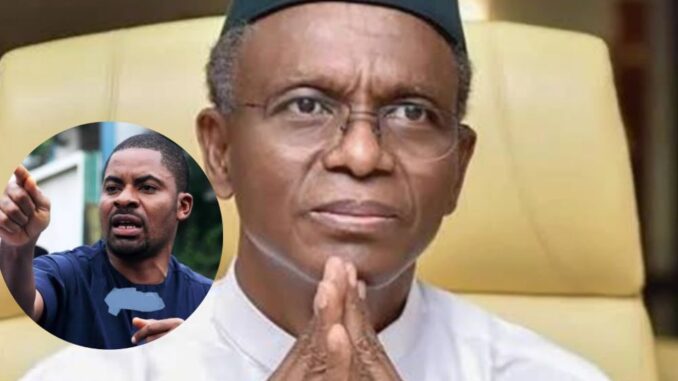
Deji Adeyanju El-Rufai phone tapping trial — Fresh details emerged on Monday in the alleged phone-tapping trial involving former Kaduna State Governor Nasir El-Rufai.
The Federal High Court in Abuja heard evidence linked to the controversial Arise Television interview at the centre of the case.
Prosecutors argued that comments made by El-Rufai during the interview amounted to an admission that someone intercepted a private conversation involving National Security Adviser (NSA) Nuhu Ribadu.
The case has attracted nationwide attention because it touches on privacy, national security, and political accountability.
A prosecution witness told the court that security operatives launched an investigation after watching the television interview.
According to the witness, DSS officials obtained and reviewed the recording before opening a formal investigation.
SEE ALSO: WATCH VIDEO: Why Did Sowore Refuse to Enter a Black Maria? Drama Rocks Abuja Court
“Not the Time to Resign” — Agbese Defends Tinubu as Insecurity Debate Intensifies
“There was a confessional statement where the defendant said he tapped the conversation of the National Security Adviser,” the witness told the court.
Prosecutors tendered the interview recording and supporting documents as evidence.
The witness said investigators questioned broadcaster Charles Aniagolu, activist-lawyer Deji Adeyanju, and the cameraman who recorded the programme.
According to the prosecution, those statements helped investigators understand the circumstances surrounding the interview.
Adeyanju’s testimony added a fresh angle to the trial.
The witness also told the court that investigators interviewed NSA Nuhu Ribadu after the programme aired.
He said Ribadu confirmed that the conversation mentioned during the interview actually took place.
The prosecution further claimed that the Chairman of the Independent Corrupt Practices and Other Related Offences Commission (ICPC) confirmed the discussion after investigators played parts of the interview to him.
“We listened to their calls, someone tapped the phone conversation and told us that he gave the order,” El-Rufai reportedly said during the interview.
Prosecutors insist that statement remains a key part of their case.
Meanwhile, defence lawyers challenged the investigation during cross-examination.
They questioned whether investigators recovered any device linked to the alleged interception.
They also asked if authorities conducted forensic examinations to support the claims.
The witness admitted that investigators did not examine the NSA’s devices.
He also confirmed that they did not trace IP addresses or conduct forensic tests to determine how anyone allegedly intercepted the conversation.
Despite those admissions, prosecutors maintained that witness testimonies and El-Rufai’s statements provided sufficient grounds for the charges.
The witness acknowledged that El-Rufai never claimed he personally carried out the interception.
However, prosecutors argued that he consistently maintained that someone intercepted the conversation and passed the information to him.
Defence counsel suggested that El-Rufai may have exaggerated during the television interview.
The witness disagreed.
“He is a person of integrity and meant what he said,” the witness responded.
El-Rufai has denied all allegations and pleaded not guilty.
His legal team argues that the prosecution relies mainly on interpretations of a television interview rather than forensic evidence.
The defence also claims political considerations influenced the case.
The court will hear more testimony and review additional evidence in the coming weeks.
The proceedings could determine whether prosecutors can establish a direct link between El-Rufai and the alleged interception of private communications.
Justice Joyce Abdulmalik adjourned the matter for further hearing.
Keyphrase: Deji Adeyanju El-Rufai phone tapping trial.
Leave a Reply