
OPINION
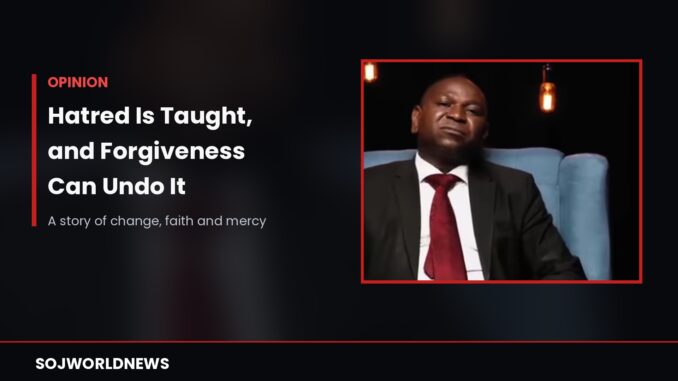
Hatred is taught, and forgiveness can undo it. Yassir Eric’s story shows both truths in painful detail. Eric, now an Anglican bishop, says he once beat a Christian classmate and left him for dead. Sojworldnews cannot verify his account, but the lessons in it deserve our attention.
Eric says his road began when he was only eight years old. His father dropped him at a Quran school, and teachers told him he belonged to the Islamic community and must fight for it. “You stay loyal to it,” they said, according to his telling. He says he soon learned to hate everyone who was not a Muslim. At 16, he and four other boys attacked the only Christian student at his school.
The most disturbing part of this story is not the violence of a few teenagers. It is the lesson that shaped them. Any teaching that trains a child to see neighbours as enemies has failed that child. However, this is a point about extremism, not about the millions of Muslims who live in peace beside people of other faiths. Nigeria knows that difference well, and we must keep it clear.
The turning point came in a hospital room. Eric’s young cousin lay close to death. Two Coptic Christians offered to pray for the boy, and Eric agreed out of politeness. The child later opened his eyes after weeks of silence, according to Eric. Whatever one believes about the healing, the contrast stands out. His teachers taught him to pray against Christians. Meanwhile, two strangers prayed for his family.
That contrast carries a lesson for us all. Kindness disarmed him in a way that arguments never did. “Because he’s alive, you can speak to him,” one of the visitors told him. In my view, people rarely change because someone shouts at them. They change when someone shows them a love they did not expect.
The story also holds a powerful example of forgiveness. In Christianity Today, Eric recalls a relative who once persecuted Christians himself. “Because you hated me so deeply, I always prayed for you,” the man told him. That is costly forgiveness. We rarely practise it. Instead, we rush to cancel, shame and punish people on social media, and we call it justice.
Still, redemption has a price, and Eric paid it. When he chose a new faith, his father and grandfather told him, “You are no longer one of us.” His family held a funeral and buried an empty coffin. I find that cruelty hard to defend. Whatever our religion, nobody should be declared dead for changing a belief. Freedom of conscience means every person can follow, change or leave a faith without fear. Moreover, it means nobody should pressure or trick another person into converting.
Another question troubles me. We hear a great deal from the attacker in this story, but little from the boy he attacked. Zakariya never returned to school, and Eric says he never saw him again. Therefore, any story of redemption should leave room for the victim. Repentance means little if we forget the person who paid for the sin.
Finally, readers should resist the urge to turn one man’s testimony into a verdict on a whole religion. Judge extremist ideas harshly, and hold those who spread them accountable. Yet treat your neighbours with fairness. Every home, school, mosque and church in Nigeria teaches children something. The real question is what we choose to teach. If we teach hatred, we will raise attackers. If we teach mercy, we may raise bridge-builders.
Leave a Reply