
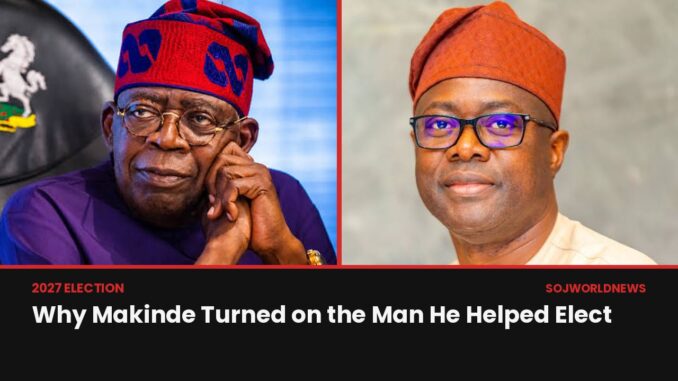
Oyo State Governor Seyi Makinde has explained why he turned against the president he backed three years ago. In a long campaign statement, the Allied Peoples Movement (APM) presidential candidate said he supported President Bola Tinubu in 2023 and now runs against him in the 2027 election. He insisted the decision does not stem from a personal quarrel. “It is about the future of Nigeria and the opportunities available to Nigerians,” he wrote.
Makinde declared his bid on May 14, 2026, at a rally in Ibadan, where leaders of a PDP faction and the APM formed an alliance. The general election is set for January 16, 2027. Meanwhile, he has presented his campaign as a “Reset Nigeria” movement and promised to serve only one four-year term.
The governor began his case with his own story. His father was a teacher who retrained as an accountant, and his mother worked as a civil servant and telephone operator. He studied electrical engineering at the University of Lagos and founded an engineering firm at 29. “Nigeria gave me the opportunity to live my dreams,” he said. Then he asked a pointed question: how many young Nigerians can expect the same chance today?
Makinde also described his road to office. He lost two Senate bids and a governorship race between 2007 and 2015. Voters elected him governor of Oyo State in 2019. He said he entered office without a political godfather, adding that he had “no godfather, only God the Father.” Furthermore, he said governing taught him lessons that business never did, and he acknowledged mistakes and apologies along the way.
When some critics urged him to wait until 2031 or 2035, he refused. He argued that poor federal decisions can undermine even a well-run state. “That is why I cannot wait,” he wrote. He warned that another four years on the current path could leave damage that is much harder to reverse.
Makinde then listed four reasons he lost confidence in the president. First, he said, the economy has gained stability without development, and strong revenue and reserve figures mean little unless they produce jobs and better incomes. Second, he accused the administration of governing by excuses, since officials still blame inherited problems after three years in office. Third, he said Tinubu’s alliances serve political goals more than the national interest, and he voiced concern about weakened opposition parties. Fourth, he said the government rolled out reforms without enough protection for struggling Nigerians.
He used petrol subsidy removal as his main example. Makinde said he supported reform of the subsidy and foreign-exchange systems, but he expected better preparation. He argued that a president-elect could have used the transition period to plan. In his version, a new president would convene the National Economic Council, agree on a response with governors and show the public how relief money was spent.
The governor pointed to his own state as proof of concept. Within eleven days of the subsidy announcement, he said, Oyo deployed more Omituntun buses, held existing fares and introduced half-price travel for students and senior citizens. By August 2023, the state launched its SAfER programme, which he said delivered food relief to 200,000 vulnerable households and supported small businesses and farmers with loans and inputs.
Makinde closed with a direct appeal to voters who have lost faith. “I am asking you not to give up on Nigeria,” he wrote, and he invited them to examine his record in Oyo and question his proposals. He said any candidate should answer four questions: what will you do, how will you do it, when will you do it, and how will we know you succeeded?
The statement reads as both a personal introduction and a campaign argument. It gives voters his account of why he switched sides, and it sets out the standard he wants judged by. Voters will now weigh that account against the record of the incumbent and the other candidates as the January vote approaches.
Leave a Reply