
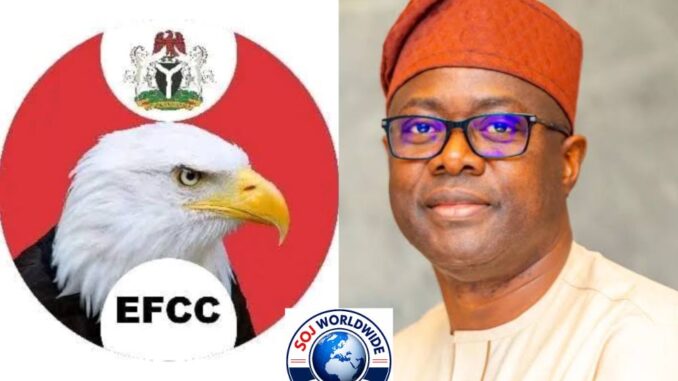
A Federal High Court sitting in Ibadan has stopped the Economic and Financial Crimes Commission (EFCC) from proceeding with its planned investigation into the finances of the Oyo State Government under Governor Seyi Makinde. Consequently, the anti-graft agency now finds itself barred from acting on a probe that the court has described as speculative and unsupported by any concrete allegation.
Justice Nkeonye Maha delivered the judgment on Wednesday in Suit No. FHC/IB/CS/61/2025, a case filed by the Oyo State Government against the commission. Although the judge acknowledged that the EFCC holds statutory powers to investigate financial crimes, she nonetheless stressed that the commission must exercise those powers strictly within the bounds of the Constitution. “Section 38 of the EFCC Act empowers the Commission to demand information only for the investigation of offences under the Act, not for speculative or roving inquiries,” the judge held, according to Sahara Reporters.
SEE ALSO: ADC Demands Explanation as NNPC’s “Energy Security” Bill Hits N7.13 Trillion
The controversy first arose after the EFCC sent a letter to the Oyo State Accountant-General on June 2, 2025, demanding copies of all contracts awarded by the state and details of every payment made to contractors between 2021 and the date of the letter. In response, the state government asked the commission to specify which contractors, companies, or transactions it intended to investigate, so that it could supply the relevant documents accordingly. However, the EFCC allegedly failed to respond to that request, and this silence ultimately prompted Governor Makinde, the state’s Attorney-General, and the Accountant-General to head to court.
Represented by Attorney-General Abiodun Aikomo, the plaintiffs argued that the commission’s demand for virtually all contract documents spanning several years was excessive and unreasonable, particularly given the sheer volume of contracts the state had executed during that period. Moreover, they contended that while the EFCC’s enabling Act does grant it investigative powers, those powers remain subject to constitutional safeguards and therefore cannot be deployed for broad, indiscriminate searches. Meanwhile, the EFCC’s counsel, I.G. Ojibor, leading S. Adamu, defended the commission’s approach by citing Section 38 of the EFCC Act (2004), which permits the commission to demand and receive information from any person, authority, or corporation without hindrance.
In the end, the court sided with the Oyo State Government. Justice Maha ruled that the EFCC’s proposed investigation — particularly the demands contained in its June 2, 2025 letter — amounted to a “fishing expedition” rather than a legitimate, targeted inquiry. Furthermore, she noted that the constitutional right of the plaintiffs to fair hearing could not be trampled upon under the guise of an investigation. As a result, the court restrained the commission from proceeding further on the basis of that letter, stressing that indiscriminate requests unsupported by specific allegations of wrongdoing cannot stand.
Ultimately, the ruling delivers a significant legal victory for the Makinde-led administration and, at the same time, sets a notable precedent regarding the limits of the EFCC’s investigative reach into state government finances.
EFCC Oyo State investigation | SojWorldNews
Leave a Reply