
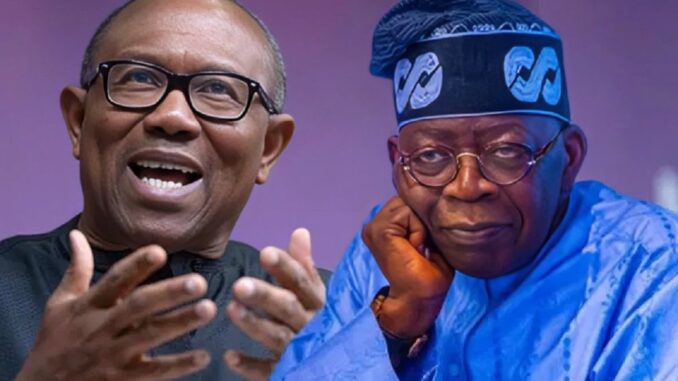
Nigeria borrowing debate – The Presidency and former presidential candidate of the Labour Party,
Peter Obi, have clashed over the Federal Government’s borrowing policy.
Their disagreement has intensified national debate on Nigeria’s rising debt profile and economic direction.
President Bola Ahmed Tinubu triggered the exchange while defending his administration’s fiscal approach.
He insisted that Nigerians should not stigmatise borrowing.
He also argued that governments worldwide use debt as a standard financial tool.
“Borrowing is not leprosy,” President Tinubu said.
He maintained that his administration uses borrowing to fund key infrastructure projects.
He added that such investments aim to support long-term growth and national development.
Furthermore, he stressed that Nigeria’s economy still attracts international lenders due to its credibility.
However, Peter Obi strongly rejected the President’s position.
He warned that borrowing without productive output could weaken the economy and burden future generations.
He argued that Nigeria must align borrowing with measurable development outcomes.
“Mr President, borrowing is not only a leprosy, but a killer cancer when it is borrowed for consumption and not production as it is in Nigeria today,” Obi said.
SEE ALSO: “Borrowing Is Not a Disease” — Tinubu Defends New Loans, But Can Nigeria Afford More Debt?
“Where Is The Money?” — Sanusi Challenges FG Over Rising Debt After Subsidy Removal
He further explained that responsible nations borrow with clear plans, strict discipline, and repayment strategies.
He emphasised that loans should finance productive sectors that create jobs and stimulate growth.
“No serious economy borrows recklessly. Nations borrow for investment, not for consumption,” he added.
Obi also referenced the Fiscal Responsibility Act, 2007.
He noted that the law requires government to justify every loan with clear purpose and cost-benefit analysis.
He insisted that many current borrowings fail to meet these legal and economic standards.
“Debt that is not tied to measurable economic value only mortgages the future of our children,” he said.
In response, presidential spokesman Bayo Onanuga dismissed Obi’s criticism.
He described it as politically driven and alarmist.
He also defended the government’s borrowing approach as globally accepted economic practice.
“Every sovereign nation borrows. Borrowing is not a disease,” Onanuga said.
He further explained that the Tinubu administration channels loans into critical infrastructure projects rather than recurrent spending.
He added that international lenders continue to support Nigeria due to confidence in its repayment capacity.
Onanuga also urged Obi to adopt a more balanced tone in his public criticism.
He encouraged national debates to focus on facts, context, and long-term economic goals.
Meanwhile, economists and political analysts remain divided over the issue.
Some support government borrowing for infrastructure development.
Others echo Obi’s concerns about rising debt, weak revenue generation, and limited returns on loans.
Nigeria’s public debt has continued to rise in recent years.
Consequently, concerns about debt sustainability and repayment pressure have grown among citizens.
Many Nigerians now question whether borrowed funds deliver real economic value.
This latest exchange highlights growing political tension over economic policy.
It also reflects deeper disagreements ahead of the 2027 general elections.
As the debate continues, Nigerians will closely watch how borrowing decisions translate into development outcomes,
infrastructure delivery, and improved living standards.
Keyphrase: Nigeria borrowing debate.


Leave a Reply